Shantang Street
| 山塘街 | |
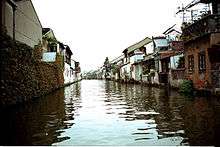 Shantang Canal | |
| Length | 3,830 m (12,570 ft) |
|---|---|
| Location | Northwestern Gusu District, Suzhou |
| Construction | |
| Inauguration | 825 AD |
| Other | |
| Status | Complete |

Shantang Street (Chinese: 山塘街; pinyin: Shāntáng Jiē; Suzhou Wu: Se daon ka, IPA: [se̞ dɑ̃ kɑ]), also known as Seven-mile Shantang (Chinese: 七里山塘), is a street in northwestern Gusu District, Suzhou, Jiangsu, China. The street connects Changmen (Chinese: 阊门) in the east with Huqiu in the west, with a total length of about 3,829.6 meters,[1] or a little more than seven li.[2]
History
Construction of the Shantang Canal (Chinese:山塘河) started in 825 AD, during the Tang Dynasty by Bai Juyi, a poet and the Cishi (modern-day equivalent of the prefectural governor) of Suzhou, to provide a link between Huqiu and the city. The sludge dug out from the construction formed a dam along the north bank of the canal known as Baigong Dam (Chinese:白公堤) in honor of Bai Juyi. A street was built on dam, which later became the modern-day Shantang Street.[2][3][4][5]
Along with Pingjiang Road, the street was declared a Historical and cultural block of China (Chinese:中国历史文化街区) in 2015.[6]
References
- ↑ "Shantang Street China Daily". Retrieved 26 July 2016.
- 1 2 "Suzhou Shantang Street - Introduction". Suzhou ponds and Tourism Development Co., Ltd. Retrieved 13 November 2012.
- ↑ 中国第一古街苏州七里山塘景区. Sohu.com (in Chinese). 16 May 2012. Retrieved 13 November 2012.
- ↑ "Shantang Street". Retrieved 26 July 2016.
- ↑ "Shantang Street (Seven-Li Shantang)". Retrieved 26 July 2016.
- ↑ "苏州平江路、山塘街被认定为首批"中国历史文化街区"". Retrieved 26 July 2016.
External links
- 苏州山塘街 - Official site (Chinese)
- Suzhou Shantang Street - Official English site
- Suzhou Shantang Kunqu Opera House - Mildchina