Sāvakabuddha
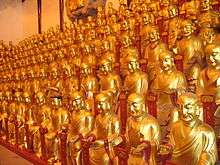
Sāvakabuddha is a Pali term used rarely in Theravada Buddhism to refer to an enlightened disciple of a Buddha. Such enlightened disciples obtained nibbāṇa by hearing the dhamma as initially taught by a sammasambuddha. A sāvakabuddha is distinguished from a sammasambuddha and a paccekabuddha. The standard designation for such a person is "arhat".
Buddhas are supposed to reach nibbāṇa by their own efforts and insights.[1] A sāvakabuddha might also lead others to enlightenment, but cannot teach the dhamma in a time or world where it has been forgotten, because they depend upon a tradition that stretches back to a sammasambuddha.
The term savakabuddha is used in Theravadin commentaries[2] but does not occur in the scriptures of the Pāli Canon.
Sāvaka means "one who hears" – a person who follows the path to enlightenment by means of hearing the instructions of others. Lay persons, who take special vows, are called sāvakas.
References
- ↑ Snelling, John (1987), The Buddhist handbook. A Complete Guide to Buddhist Teaching and Practice. London: Century Paperbacks. Page 81
- ↑ Udana Commentary, tr Peter Masefield, volume I, 1994, Pali Text Society, page 94; Theragatha commentary, PTS edition, volume I, page 10, not yet translated, cited by Pruitt in Journal of the Pali Text Society, volume XXIX, forthcoming