Simple shear
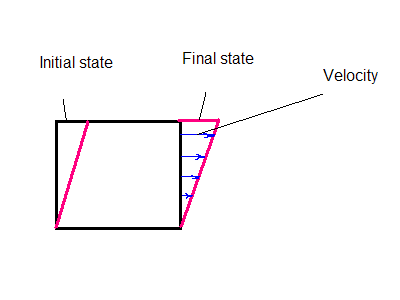
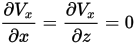
In fluid mechanics, simple shear is a special case of deformation where only one component of velocity vectors has a non-zero value:


And the gradient of velocity is constant and perpendicular to the velocity itself:
- ,

where is the shear rate and:

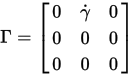
The displacement gradient tensor Γ for this deformation has only one nonzero term:
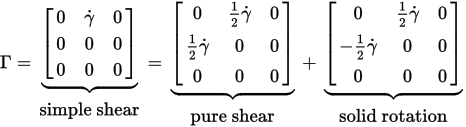
Simple shear with the rate is the combination of pure shear strain with the rate of 1/2 and rotation with the rate of 1/2:
Important examples of simple shear include laminar flow through long channels of constant cross-section (Poiseuille flow), and elastomeric bearing pads in base isolation systems to allow critical buildings to survive earthquakes undamaged.
Simple shear in solid mechanics
In solid mechanics, a simple shear deformation is defined as an isochoric plane deformation in which there are a set of line elements with a given reference orientation that do not change length and orientation during the deformation.[1] This deformation is differentiated from a pure shear by virtue of the presence of a rigid rotation of the material.
If e1 is the fixed reference orientation in which line elements do not deform during the deformation and e1 − e2 is the plane of deformation, then the deformation gradient in simple shear can be expressed as
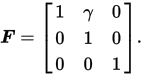
We can also write the deformation gradient as

See also
References
- ↑ Ogden, R. W. (1984). Non-Linear Elastic Deformations. Dover.