Yellow-fruit nightshade
| Solanum virginianum | |
|---|---|
 | |
| Scientific classification | |
| Kingdom: | Plantae |
| (unranked): | Angiosperms |
| (unranked): | Eudicots |
| (unranked): | Asterids |
| Order: | Solanales |
| Family: | Solanaceae |
| Genus: | Solanum |
| Species: | S. virginianum |
| Binomial name | |
| Solanum virginianum L., 1753 | |
| Synonyms[1] | |
| |
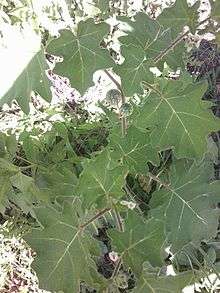
Solanum virginianum, also called Surattense nightshade,[2] yellow-fruit nightshade, yellow-berried nightshade, Thai green eggplant, Thai striped eggplant (from the unripe fruit),[3] is a species of nightshade native to Asia (Saudi Arabia, Yemen, Afghanistan, Iran, China, Bangladesh, India, Nepal, Pakistan, Sri Lanka, Myanmar, Thailand, Vietnam, Indonesia, Malaysia), and is adventive in Egypt. It is a medicinal plant used in India, but the fruit is poisonous.[4]
Description
The ripe yellow fruits are around 3 cm of diametre.[5]
Traditional medicine
In the tribes of Nilgiris, the plant is used to treat a whitlow (finger abscess): the finger is inserted into a ripe fruit for a few minutes.[5] In Nepal, a decoction of root is taken twice a day for seven days to treat cough, asthma and chest pain.[6]
Gallery
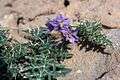 The plant
.jpg) The flowers
The flowers The immature fruits
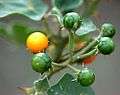 Unripe (green) and ripe (yellow)
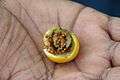 A fruit opened
See also
 |
Wikimedia Commons has media related to Solanum virginianum. |
- Asian eggplants:
- Thai eggplant, common cultivar types in Thailand are 'Thai Purple', 'Thai Green', 'Thai Yellow', and 'Thai White' (cultivars of Solanum melongena).
- Lao eggplant for common cultivar types in Laos such as 'Lao Green Stripe', 'Lao Purple Stripe', 'Lao Lavender', and 'Lao White' (cultivars of Solanum melongena).
- African eggplant, gboma, or gboma eggplant (Solanum macrocarpon): Cà pháo is used too in Vietnamese cuisine (Vietnamese eggplant?)
References
- ↑ "The Plant List: A Working List of All Plant Species". Retrieved 10 January 2015.
- ↑ "Solanum virginianum". Natural Resources Conservation Service PLANTS Database. USDA. Retrieved 17 November 2015.
- ↑ René T. J. Cappers, Reinder Neef, Renée M. Bekker, Digital Atlas of Economic Plants: Acanthaceae - Hypoxidaceae, Vol. 2A, Barkhuis, 2009, p. 269
- ↑ Michel H. Porcher , Know your eggplants - Part 4:The related Nightshades
- 1 2 Rémi Tournebize, Points on the ethno-ecological knowledge and practices among four Scheduled Tribes of the Nilgiris: Toda, Kota, Alu Kurumba and Irula, with emphasis on Toda ethnobotany, Institute of Research for Development (Marseille), Thesis 2013, p. 103
- ↑ RB Mahato, RP Chaudhary, Ethnomedicinal study and antibacterial activities of selected plants of Palpa district, Nepal, Scientific World, Vol. 3, No. 3, July 2005, p. 29[4]
External links
- "Solanum virginianum L.". Germplasm Resources Information Network (GRIN).
- "Solanum virginianum L.". National Center for Biotechnology Information (NCBI).