Square root of a 2 by 2 matrix
A square root of a 2 by 2 matrix M is another 2 by 2 matrix R such that M = R2, where R2 stands for the matrix product of R with itself. In general there can be no, two, four or even an infinitude of square root matrices. In many cases such a matrix R can be obtained by an explicit formula.
A 2 × 2 matrix with two distinct nonzero eigenvalues has four square roots. A positive-definite matrix has precisely one positive-definite square root.
Square roots of a matrix of any dimension come in pairs: If R is a square root of M, then –R is also a square root of M, since (–R)(–R) = (–1)(–1)(RR) = R2 = M.
One formula

where A, B, C, and D may be real or complex numbers. Furthermore, let τ = A + D be the trace of M, and δ = AD - BC be its determinant. Let s be such that s2 = δ, and t be such that t2 = τ + 2s. That is,

Then, if t ≠ 0, a square root of M is
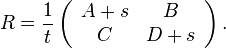
Indeed, the square of R is
![\begin{array}{rcl}
R^2
&=&
\displaystyle \frac{1}{t^2}
\left( \begin{array}{cc} (A + s)^2 + B C & (A + s)B + B(D + s) \\ C(A + s) + (D + s)C & (D + s)^2 + B C \end{array}\right)\\[3ex]
{}
&=&
\displaystyle \frac{1}{A + D + 2 s}
\left( \begin{array}{cc} A(A + D + 2s) & (A + D + 2s)B \\ C(A + D + 2 s) & D(A + D + 2 s) \end{array}\right) \;=\;
M.
\end{array}](../I/m/0a86ad85ebf3fccab1a13fbb38dab016.png)
Note that R may have complex entries even if M is a real matrix; this will be the case, in particular, if the determinant δ is negative. Also, note that R is positive when s>0 and t>0.
Special cases of the formula
If M is an idempotent matrix, meaning that MM = M, then if it is not the identity matrix its determinant is zero, and its trace equals its rank which (excluding the zero matrix) is 1. Then the above formula has s = 0 and  = 1, giving M and -M as two square roots of M.
In general, the formula above will provide four distinct square roots R, one for each choice of signs for s and t. If the determinant δ is zero but the trace τ is nonzero, the formula will give only two distinct solutions. It also gives only two distinct solutions if δ is nonzero and τ2 = 4δ (the case of duplicate eigenvalues), in which case one of the choices for s will make the denominator t be zero.
The formula above fails completely if δ and τ are both zero; that is, if D = −A and A2 = −BC, so that both the trace and the determinant of the matrix are zero. In this case, if M is the null matrix (with A = B = C = D = 0), then the null matrix is also a square root of M, as are

for any real or complex values of b and c. Otherwise M has no square root.
Simpler formulas for special matrices
Diagonal matrix
If M is diagonal (that is, B = C = 0), one can use the simplified formula
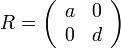
where a = ±√A and d = ±√D; which, depending on the sign choices, gives four, two, or one distinct matrices, if none of, only one of, or both A and D are zero, respectively.
Identity matrix
Because it has duplicate eigenvalues, the 2×2 identity matrix  has infinitely many symmetric rational square roots given by


 and
and 
where (r, s, t) is any Pythagorean triple—that is, any set of positive integers such that  [3] In addition, any non-integer, irrational, or complex values of r, s, t satisfying
  give square root matrices. The identity matrix also has infinitely many non-symmetric square roots.
Matrix with one off-diagonal zero
If B is zero but A and D are not both zero, one can use
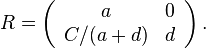
This formula will provide two solutions if A = D, and four otherwise. A similar formula can be used when C is zero but A and D are not both zero.
References
- ↑ Levinger, Bernard W.. 1980. “The Square Root of a 2 × 2 Matrix”. Mathematics Magazine 53 (4). Mathematical Association of America: 222–24. doi:10.2307/2689616.
- ↑ P. C. Somayya (1997), Root of a 2x2 Matrix, The Mathematics Education, Vol.. XXXI, no. 1. Siwan, Bihar State. INDIA
- ↑ Mitchell, Douglas W. "Using Pythagorean triples to generate square roots of I2". The Mathematical Gazette 87, November 2003, 499-500.