Steephead valley
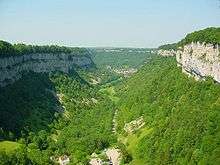
A steephead valley, steephead or blind valley is a deep, narrow, flat bottomed valley with an abrupt ending. Such closed valleys may arise in limestone or karst landscapes, where a layer of permeable rock lies above an impermeable substrate such as marl. Water flowing through a steephead valley leaves via one or more ponors[1] or sinkholes.
Blind valleys are typically dry at their lower ends.[2] A blind valley can also be dry. If the ponor cannot contain the high runoff during a flood event an intermittent flow may continue through the valley beyond the sink. Such a landform is called a semi-blind or half-blind valley.[3]
Development
They are created by a stream flowing within the permeable rock and eroding it from within, until the rock above collapses opening up a steep narrow valley which is then further eroded by the stream running across the impermeable valley floor. At the head of the valley the stream emerges from the rock as a spring. Notable examples can be found in the Jura region of France, for example the Reculée de Baume at Baume-les-Messieurs and the Reculée d'Arbois with its head at Les Planches-près-Arbois and its exit at Arbois.
In North America, blind valleys (the preferred American term) are found in the Driftless Area and other karst regions.
See also
References
- ↑ Gutiérrez, Francisco; Mateo Gutiérrez (2016). Landforms of the Earth: An Illustrated Guide. Springer. p. 68. ISBN 9783319269474. Retrieved 26 November 2016.
- ↑ Heggen, Richard (2015). Underground Rivers: From the River Styx to the Rio San Buenaventura, with occasional diversions. Richard Heggen. p. 647. Retrieved 26 November 2016.
- ↑ Huggett, Richard J. (2003). Fundamentals of Geomorphology. Psychology Press. p. 152. ISBN 0415241464. Retrieved 26 November 2016.