Stein's lemma
Stein's lemma,[1] named in honor of Charles Stein, is a theorem of probability theory that is of interest primarily because of its applications to statistical inference — in particular, to James–Stein estimation and empirical Bayes methods — and its applications to portfolio choice theory. The theorem gives a formula for the covariance of one random variable with the value of a function of another, when the two random variables are jointly normally distributed.
Statement of the lemma
Suppose X is a normally distributed random variable with expectation μ and variance σ2. Further suppose g is a function for which the two expectations E(g(X) (X − μ) ) and E( g ′(X) ) both exist (the existence of the expectation of any random variable is equivalent to the finiteness of the expectation of its absolute value). Then

In general, suppose X and Y are jointly normally distributed. Then

Proof
In order to prove the univariate version of this lemma, recall that the probability density function for the normal distribution with expectation 0 and variance 1 is
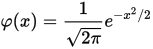
and that for a normal distribution with expectation μ and variance σ2 is
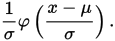
Then use integration by parts.
More general statement
Suppose X is in an exponential family, that is, X has the density

Suppose this density has support where could be and as , where is any differentiable function such that or if finite. Then




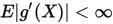


The derivation is same as the special case, namely, integration by parts.
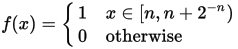
If we only know has support , then it could be the case that but . To see this, simply put and with infinitely spikes towards infinity but still integrable. One such example could be adapted from so that is smooth.






Extensions to elliptically-contoured distributions also exist.[2][3]
See also
References
- ↑ Ingersoll, J., Theory of Financial Decision Making, Rowman and Littlefield, 1987: 13-14.
- ↑ Hamada, Mahmoud; Valdez, Emiliano A. (2008). "CAPM and option pricing with elliptically contoured distributions". The Journal of Risk & Insurance. 75 (2): 387–409. doi:10.1111/j.1539-6975.2008.00265.x.
- ↑ Landsman, Zinoviy; Nešlehová, Johanna (2008). "Stein's Lemma for elliptical random vectors". Journal of Multivariate Analysis. 99 (5): 912––927. doi:10.1016/j.jmva.2007.05.006.