Streaked xenops
| Streaked xenops | |
|---|---|
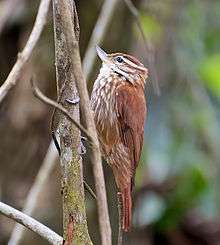 | |
| In Piraju, São Paulo, Brazil | |
| Scientific classification | |
| Kingdom: | Animalia |
| Phylum: | Chordata |
| Class: | Aves |
| Order: | Passeriformes |
| Family: | Furnariidae |
| Subfamily: | Dendrocolaptinae |
| Tribe: | Xenopini |
| Genus: | Xenops |
| Species: | X. rutilans |
| Binomial name | |
| Xenops rutilans Temminck, 1821 | |
The streaked xenops (Xenops rutilans) is a passerine bird which breeds in the tropical New World from Costa Rica and Trinidad south to Bolivia and northern Argentina. Like the closely related true woodcreepers, it is a member of the South American bird family Furnariidae.
The streaked xenops is typically 4.8 in (12.2 cm) long, weighs 0.44 oz (12.6 g), and has a stubby wedge-shaped bill. The head is dark brown with a whitish supercilium and malar stripe. The upperparts are brown, becoming rufous on the tail and rump, and there is a buff bar on the darker brown wings. The underparts are white-streaked olive brown. Males and females looks alike. Visually inconspicuous, it is easier located by its chattering call, a series of 5 or 6 metallic zeet notes.
It is found in wet forests in foothills and mountains between 2,000-7,200 ft (600-2,200 m) ASL, and will utilize secondary forests and opened-up growth.[2] The streaked xenops is often difficult to see as it forages on bark, rotting stumps or bare twigs;[2] it moves in all directions on the trunk like a treecreeper, but does not use its tail as a prop. It feeds on arthropods such as the larvae of wood-boring beetles, but can also catch flying termites in mid-air.[3] It joins mixed-species feeding flocks on a more or less regular basis depending on location, usually moving through the middle levels of the forest.[4]
The streaked xenops builds its nest by simply placing a few stems and roots in a hole 5–15 ft (1.5-4.5 m) high in a tree. The normal clutch is two white eggs, incubated by both sexes.
Footnotes
- ↑ BirdLife International (2012). "Xenops rutilans". IUCN Red List of Threatened Species. Version 2013.2. International Union for Conservation of Nature. Retrieved 26 November 2013.
- 1 2 de L. Fávaro et al. (2006)
- ↑ Olson & Alvarenga (2006)
- ↑ Machado (1999), Olson & Alvarenga (2006)
References
- de L. Fávaro, Fernando; dos Anjos, Luiz; Lopes, Edson V.; Mendonça, Luciana B. & Volpato, Graziele H. (2006): Efeito do gradiente altitudinal/latitudinal sobre espécies de aves florestais da família Furnariidae na Bacia do Rio Tibagi, Paraná, Brasil [Effect of altitudinal/latitudinal gradient about forest ovenbirds species (Aves: Furnariidae) in the Tibagi river basin, Paraná, Brazil]. Revista Brasileira de Zoologia 23(1): 261–266 [Portuguese with English abstract]. doi:10.1590/S0101-81752006000100020 PDF fulltext
- ffrench, Richard; O'Neill, John Patton & Eckelberry, Don R. (1991): A guide to the birds of Trinidad and Tobago (2nd edition). Comstock Publishing, Ithaca, N.Y.. ISBN 0-8014-9792-2
- Hilty, Steven L. (2003): Birds of Venezuela. Christopher Helm, London. ISBN 0-7136-6418-5
- Machado, C.G. (1999): A composição dos bandos mistos de aves na Mata Atlântica da Serra de Paranapiacaba, no sudeste brasileiro [Mixed flocks of birds in Atlantic Rain Forest in Serra de Paranapiacaba, southeastern Brazil]. Revista Brasileira de Biologia 59(1): 75-85 [Portuguese with English abstract]. doi:10.1590/S0034-71081999000100010 PDF fulltext
- Olson, Storrs L. & Alvarenga, Herculano M. F. (2006): An extraordinary feeding assemblage of birds at a termite swarm in the Serra da Mantiqueira, São Paulo, Brazil. Revista Brasileira de Ornitologia 14(3): 297-299 [English with Portuguese abstract]. PDF fulltext
External links
- Streaked xenops videos, photos & sounds on the Internet Bird Collection