Take Root
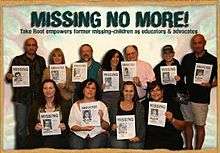
Take Root, a non-profit organization established on a grant from the United States Department of Justice,[1][2][3] is the first missing-child organization ever founded by former abducted children.[4][5] Founded in 2003 and incorporated as a 501(c)(3) in 2005, over five hundred former abducted children have participated, providing peer support to fellow former abducted children, advocating on child-abduction issues from the child-victim's perspective, and providing landmark information on the victimology of child-abduction to multidisciplinary professionals, impacted families, and the public.[5] The agency's mission is to "insert the voice of the primary victim into public and policy discussions on abduction, using the collected wisdom of former missing-children to improve America's missing-child response." Their tags-line are "beyond recovering missing-children; to helping missing-children recover" and, "where missing children are seen and heard." Take Root is the brain child of Melissa "Liss" Haviv, a Fulbright Scholar in cultural anthropology and former abduction victim who is considered a leading expert in the victimology of long term child abduction [5][6][7][8]
See also
References
- ↑ Take Root official web site home page See note in lower left-hand corner of home page; retrieved October 19, 2007
- ↑ Office of Juvenile Justice and Delinquency Prevention Programs government web site retrieved October 19, 2007
- ↑ Practitioner Resources web site on grants retrieved October 19, 2007
- ↑ "When The Missing Return, Recovery Is Long, Too". NPR.org. Retrieved 2016-11-25.
- 1 2 3 Broughton, Daniel D. (2015-09-10). Perspectives on Missing Persons Cases. Carolina Academic Press. ISBN 9781611635164.
- ↑ NPR story on Take Root
- ↑ Take Root official web site
- ↑ "Family abduction takes bitter toll on victims". msnbc.com. 2006-05-15. Retrieved 2016-11-25.
- Belzman, Josh, "Victims of Family Abduction Speak Out", MSNBC.com, May 14.
- Feeg, Veronica, "What is Not Part of the Child Abduction News Story?", Journal of Pediatric Nursing (Jannetti) 33 (1), Jan-Feb 2007.
- Office of Juvenile Justice & Delinquency Prevention, What About Me? Coping With the Abduction of a Brother or Sister (published 2007).
- Hammer, Nancy, "The Myths and Truths of Family Abduction", USA Today, Sept 2003.
- Pressley, Sue Ann, "Left in a Life of Uncertainty", The Washington Post, June 6, 2006:A01.
- Halloran, Liz, "When the Missing Return Recovery is Long Too", NPR, May 15, 2013