Tapis (Indonesian weaving style)
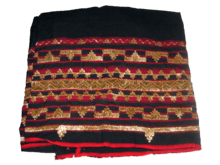
Tapis (Indonesian: kain tapis) is a traditional weaving style from Lampung, Indonesia. The word tapis also refers to the resulting cloth. It consists of a striped, naturally-coloured cloth embroidered with warped and couched gold thread. Traditionally using floral motifs, it has numeorus variations. It is generally worn ceremonially, although it can be used as a decoration. It is considered one of the symbols of Lampung.
Production
Tapis is generally made by Lampungese women. It consists of a woven, naturally coloured fabric with warped gold and silk embroidery.[1][2] The gold thread, shaped in stripes, chevrons, and checks, contrasts the colours of the fabric.[1][2] Tapis can also be decorated with beads, mica chips, or old colonial coins.[1][3][4]
_in_adatkostuum_TMnr_10002793.jpg)
The gold embroidery is affixed using couching techniques, minimalizing waste.[5] The gold thread is attached in sections, then couched with a different, less expensive, thread at turns. This ensures that none of the gold thread is used in a non-visible area.[5][6]
Traditionally, tapis has floral motifs. However, modern tapis may also be based on the weaver's own design and include non-floral motifs, such as Arabic calligraphy.[4] Other designs may include snakes, ships, and mythical creatures.[2] Some tapis, called tapis tua (old tapis), are covered entirely in golden embroidery.[7]
Although generally produced by Lampungese home industries, tapis is also produced in other areas, including Kendal, Central Java[1] and Pisang Island.[8]
Use
Traditionally, tapis is worn as a sarong for weddings, Eid ul-Fitr celebrations, and welcoming ceremonies. However, tapis can also be used as a wall decoration.[4] When worn, it forms a cylinder around the wearer's legs.[9]
Reception
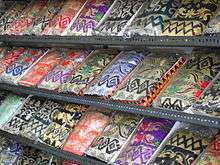
Tapis has come to be seen as a symbol of Lampung.[1]
Stevie Emilia of the Jakarta Post describes tapis as having "exceptional beauty and sophistication",[10] while Jill Forshee describes viewing tapis as "like seeing countless possibilities in art and life portrayed in cloth".[6]
The price of tapis reflects its age. Generally, the older a tapis the more it costs. Antique tapis are also collectors items, collected by both Indonesians and foreigners.[1]
References
- Footnotes
- 1 2 3 4 5 6 Oyos Saroso (22 January 2007). "Rusiana Makki, empowering women through 'tapis'". The Jakarta Post. Retrieved 6 August 2011.
- 1 2 3 Maxwell 2003, pp. 112–113
- ↑ Rodgers, Summerfield & Summerfield 2007, p. 36
- 1 2 3 Nia S. Kim (10 June 2001). "Lampung offers a whole lot more besides jungle adventures". The Jakarta Post. Retrieved 6 August 2011.
- 1 2 Maxwell 2003, p. 316
- 1 2 Forshee 2006, p. 144
- ↑ (Maxwell 2003, p. 184)
- ↑ Backshall 2003, p. 502
- ↑ Maxwell 2003, p. 319
- ↑ Stevie Emilia (10 April 2011). "Journeying through textile traditions". The Jakarta Post. Retrieved 6 August 2011.
- Bibliography
- Backshall, Stephen (2003). The Rough Guide to Indonesia. Rough Guides. p. 565. ISBN 1-85828-991-2. Retrieved 20 December 2010.
- Forshee, Jill (2006). Culture and Customs of Indonesia. Westport, Connecticut: Greenwood Press. ISBN 978-0-313-33339-2. Retrieved 6 August 2011.
- Maxwell, Robyn J. (2003). Textiles of Southeast Asia : Tradition, Trade, and Transformation. Hong Kong: Periplus. ISBN 978-0-7946-0104-1. Retrieved 6 August 2011.
- Rodgers, Susan; Summerfield, Anne; Summerfield, John (2007). Gold Cloths of Sumatra : Indonesia's Songkets from Ceremony to Commodity. Leiden: KITLV Press. ISBN 978-90-6718-312-3. Retrieved 6 August 2011.