Tautology (rule of inference)
| Transformation rules |
|---|
| Propositional calculus |
| Rules of inference |
| Rules of replacement |
| Predicate logic |
In propositional logic, tautology is one of two commonly used rules of replacement.[1][2][3] The rules are used to eliminate redundancy in disjunctions and conjunctions when they occur in logical proofs. They are:
The principle of idempotency of disjunction:

and the principle of idempotency of conjunction:

Where "" is a metalogical symbol representing "can be replaced in a logical proof with."

Formal notation
Theorems are those logical formulas where is the conclusion of a valid proof,[4] while the equivalent semantic consequence indicates a tautology.


The tautology rule may be expressed as a sequent:

and

where is a metalogical symbol meaning that is a syntactic consequence of , in the one case, in the other, in some logical system;


or as a rule of inference:

and

where the rule is that wherever an instance of "" or "" appears on a line of a proof, it can be replaced with "";
or as the statement of a truth-functional tautology or theorem of propositional logic. The principle was stated as a theorem of propositional logic by Russell and Whitehead in Principia Mathematica as:
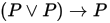
and
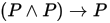
where is a proposition expressed in some formal system.