Tempus fugit
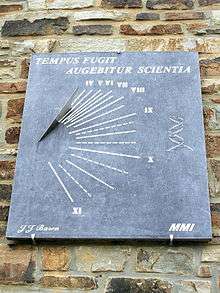
Tempus fugit is a Latin phrase, usually translated into English as "time flies". The expression comes from line 284 of book 3 of Virgil's Georgics,[1] where it appears as fugit inreparabile tempus: "it escapes, irretrievable time". The phrase is used in both its Latin and English forms as a proverb that "time's a-wasting". Tempus fugit, however, is typically employed as an admonition against sloth and procrastination (cf. carpe diem) rather than a motto in favor of licentiousness (cf. "gather ye rosebuds while ye may"); the English form is often merely descriptive: "time flies like the wind", "time flies when you're having fun".
The phrase's full appearance in the Georgics is:
| Original (Vergil)[1] |
Translation (Dryden)[2] |
Translation (Rhoades)[3] |
|---|---|---|
| Omne adeo genus in terris hominumque ferarumque | Thus every Creature , and of every Kind , The secret Joys of sweet Coition find : Not only Man's Imperial Race ; . . . |
Nay, every race on earth of men, and beasts, |
| et genus aequoreum, pecudes pictaeque volucres, | . . . but they That wing the liquid Air ; or swim the Sea , Or haunt the Desart , . . . |
And ocean-folk, and flocks, and painted birds, |
| in furias ignem que ruunt: amor omnibus idem. ... | . . . rush into the flame : For Love is Lord of all ; and is in all the same . |
Rush to the raging fire: love sways them all. |
| Sed fugit interea, fugit inreparabile tempus, | But time is lost , which never will renew , | Fast flies meanwhile the irreparable hour, |
| singula dum capti circumvectamur amore. | While we too far the pleasing Path pursue ; Surveying Nature , with too nice a view . |
As point to point our charmed round we trace. |
The phrase is a common motto, particularly on sundials and clocks.
See also
- Time flies like an arrow; fruit flies like a banana
- ars longa, vita brevis; carpe diem; memento mori
- (Italian) breve et inreparabile tempus omnibus est vitae
References
- 1 2 Vergilius Maro, Publius. Georgicon, III. c. 29 BC. Hosted at Wikisource. (Latin)
- ↑ Dryden, John (trans.). The Works of Virgil: Containing His Pastorals, Georgics, and Æneis, 3rd ed., Vol. I, pp. 163–166. Jacob Tonson (London), 1709. Hosted at Google Books. Accessed 30 May 2014.
- ↑ Rhoades, James (trans.). Bucolics, Aeneid, and Georgics of Vergil. Ginn & Co. (Boston), 1900. Hosted at MIT. Accessed 30 May 2014.
External links
 |
Wikimedia Commons has media related to Tempus fugit. |
-
 The dictionary definition of tempus fugit at Wiktionary
| Key concepts | |||||||||||
|---|---|---|---|---|---|---|---|---|---|---|---|
| Measurement and standards |
| ||||||||||
| Clocks | |||||||||||
| |||||||||||
| |||||||||||
| Philosophy of time | |||||||||||
| Human experience and use of time |
| ||||||||||
| Time in |
| ||||||||||
| Related topics | |||||||||||
 Time portal Time portal | |||||||||||