Teresa Feoderovna Ries
| Teresa Feoderovna Ries | |
|---|---|
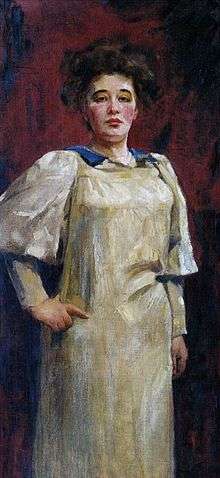 Self-portrait, 1902 | |
| Born | 1874 |
| Died | 1950 (aged 75–76) |
| Known for | Sculpture, painting |
Teresa Feoderovna Ries (also known as Theresa Feoderovna Ries) (1874–1950)[1] was a Russian-born Austrian sculptor and painter.
Life and work
Teresa Ries was born in Russia to a Jewish family. She attended the Moscow School of Painting, Sculpture and Architecture. She was expelled for showing disrespect toward a professor in one of her classes.[2][3] She moved to Vienna at the age of 21, where her first exhibition at the Vienna Künstlerhaus included Witch, a sculpture of a nude woman clipping her toenails.[4] This piece caught the attention of Kaiser Franz Joseph I,[3] and she soon became highly celebrated throughout Vienna.[4] The exhibition was also attended by Gustav Klimt, an active member of the Vienna Secession movement, who asked her to exhibit with them.[3] She sought out Edmund Hellmer as a mentor; at first he refused, saying that "it was pointless to teach women since they married anyway".[1] Hellmer eventually relented and helped her to exhibit her work and to gain commissions.[1]
In 1900 Ries exhibited at the Paris World's Fair and the 1911 World's Fair in Turin on the invitation of both Russia and Austria.[3] Prince Alois of Lichtenstein offered her the use of a suite of rooms beside his own picture gallery as a studio.[3]
Working in stone, marble, plaster, and bronze,[5] Ries produced both private and public works during her career. Some of her well known nude sculptures are Sleepwaker (pre-1894),[6] Lucifer (c. 1897),[7] and Death (1898).[8] She produced sculptures and busts for public spaces; her Bust of Jaromir Mundy (1897) is mounted on the outside of the Vienna Fireman's Association building.[9] She is perhaps best known for photographing and creating a bust of Mark Twain during the time he resided in Vienna.[10][11][12]
According to art critic Karl Kraus, "her exhibitions received too much publicity".[3] Ries published her memoir, Die Sprache des Steines (The Language of Stone) in 1928.[13] In 1938 she was evicted from her gallery and studio space due to the Nazi policy of Aryanization. She continued to work in Vienna until 1942[3] and then immigrated to Lugano, Switzerland.[5][12]
Personal life
Ries married, lost a child, and divorced while still a teenager in Moscow.[2]
References
- 1 2 3 Ben-Eli, Birgit (1 March 2009). "Austria: Jewish Women Artists". Jewish Women: A Comprehensive Historical Encyclopedia. Jewish Women's Archive. Retrieved 26 June 2016.
- 1 2 Johnson 2012, p. 205.
- 1 2 3 4 5 6 7 "The Forgotten Women Artists of Vienna 1900". 24 June 2012.
- 1 2 Johnson 2012, p. 209.
- 1 2 Johnson 2012, p. 203.
- ↑ Johnson 2012, p. 207.
- ↑ Johnson 2012, pp. 1–2.
- ↑ Johnson 2012, pp. 203–204.
- ↑ Johnson 2012, p. 208.
- ↑ Johnson 2012, pp. 218–219.
- ↑ "Literary Pickups". Book Notes: A Monthly Literary Magazine and Review of New Books. 1: 288. November 1898.
- 1 2 Ivry, Benjamin (12 January 2013). "Turn-of-Century Vienna Artists Deserve Second Look". The Forward. Retrieved 26 June 2016.
- ↑ Johnson 2012, p. 2.
Sources
- Johnson, Julie M. (2012). The Memory Factory: The Forgotten Women Artists of Vienna 1900. Purdue University Press. ISBN 978-1-55753-613-6.