Terræ filius
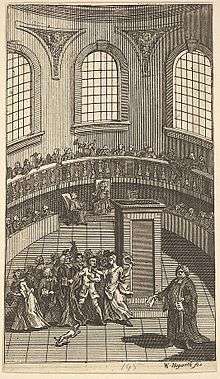
Frontispiece to Terrae-filius, Or, The Secret History of the University of Oxford (1726), by William Hogarth
The terræ filius (son of the soil) was a satirical orator who spoke at public ceremonies of the University of Oxford, for over a century. There was official sanction for personal attacks, but some of the speakers overstepped the line and fell into serious trouble. The custom was terminated during the 18th century.[1][2] The comparable speaker at the University of Cambridge was called "prevaricator".[3]
The bawdy poem The Oxford-Act (1693) contains a terræ filius speech, and is attributed to Alicia D'Anvers.[4] Nicholas Amherst took Terrae-filius, Or, The Secret History of the University of Oxford for the title of a series of periodical essays appearing from 1721, making up a 1726 book.[5]
List of terræ filii
This list is incomplete; you can help by expanding it.
- 1592 John Hoskins, expelled[6]
- 1651 William Levinz[7]
- 1655 Robert Whitehall[8]
- 1657 Lancelot Addison, forced to retract.[9]
- 1661 (one of several) Arthur Brett[10]
- 1673 John Shirley[11]
- 1676 (one of two) Balthazar Vigures, expelled[12]
- 1682 Jacob Allestry[13]
- 1703 Robert Roberts;[14] this year William Delaune was attacked[15]
- 1713 Bernard Gardiner suppressed a Whig speech, as a threat to political stability.[16]
Notes
- ↑ John Dougill (19 October 2010). Oxford in English Literature: The Making, and Undoing, Of the English Athens. AuthorHouse. p. 306. ISBN 978-1-4670-0467-1.
- ↑ Cuthbert Bede (1865). The Rook's Garden: Essays and Sketches. Sampson Low, Son, and Marston. p. 196.
- ↑ Dale B. J. Randall; Jackson C. Boswell (29 January 2009). Cervantes in Seventeenth-Century England: The Tapestry Turned: The Tapestry Turned. OUP Oxford. p. 321 note 10. ISBN 978-0-19-156158-0.
- ↑ Nelson, Holly Faith. "D'Anvers, Alicia". Oxford Dictionary of National Biography (online ed.). Oxford University Press. doi:10.1093/ref:odnb/74080. (Subscription or UK public library membership required.)
- ↑ Nicholas Amhurst (2004). Terrae-filius, Or, The Secret History of the University of Oxford, 1721-1726. University of Delaware Press. pp. 13–5. ISBN 978-0-87413-801-6.
- ↑
 Lee, Sidney, ed. (1891). "Hoskins, John (1566-1638)". Dictionary of National Biography. 27. London: Smith, Elder & Co.
 - ↑ Lee, Sidney, ed. (1893). "Levinz, William". Dictionary of National Biography. 33. London: Smith, Elder & Co.
- ↑ Christopher Wordsworth, Social Life at the English Universities in the Eighteenth Century (1874) p. 296; archive.org.
- ↑ Stephen, Leslie, ed. (1885). "Addison, Lancelot". Dictionary of National Biography. 1. London: Smith, Elder & Co.
- ↑ Pritchard, Jonathan. "Brett, Arthur". Oxford Dictionary of National Biography (online ed.). Oxford University Press. doi:10.1093/ref:odnb/3342. (Subscription or UK public library membership required.)
- ↑ Lee, Sidney, ed. (1897). "Shirley, John (1648-1679)". Dictionary of National Biography. 52. London: Smith, Elder & Co.
- ↑ Annals of the universe: containing an account of the most memorable actions, affairs, and occurrences which have happen'd in the world: but especially in Europe. From the year 1660. where Mr. Whitlock leaves off, to the year 1680. In two decades: with an index to the whole. Being a continuation of the said Mr. Whitlock's Memorials. London: printed for William Carter, and to be sold by John Morphew. 1709. p. 347. Retrieved 18 October 2014.
- ↑ Stephen, Leslie, ed. (1885). "Allestry, Jacob". Dictionary of National Biography. 1. London: Smith, Elder & Co.
- ↑ Bodleian Library (1860). Catalogi codicum manuscriptorum bibliothecae Bodleianae ... p. 35.
- ↑ Stephen, Leslie, ed. (1888). "Delaune, William (1659-1728)". Dictionary of National Biography. 14. London: Smith, Elder & Co.
- ↑ Gibson, William. "Gardiner, Bernard". Oxford Dictionary of National Biography (online ed.). Oxford University Press. doi:10.1093/ref:odnb/10355. (Subscription or UK public library membership required.)
This article is issued from Wikipedia - version of the 10/16/2016. The text is available under the Creative Commons Attribution/Share Alike but additional terms may apply for the media files.