The Sparrow's Nest
Behold, within the leavy shade,
Those bright blue eggs together laid !
On me the chance-discovered sight
Gleamed like a vision of delight.
I started—seeming to espy
The home and sheltered bed,
The Sparrow’s dwelling, which, hard by
My Father’s house, in wet or dry
My sister Emmeline and I
Together visited.
She looked at it and seemed to fear it ;
Dreading, tho’ wishing, to be near it :
Such heart was in her, being then
A little Prattler among men.
The Blessing of my later years
Was with me when a boy :
She gave me eyes, she gave me ears ;
And humble cares, and delicate fears ;
A heart, the fountain of sweet tears ;
And love, and thought, and joy.
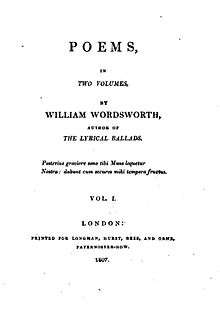
The Sparrows Nest is a lyric poem written by William Wordsworth at Town End, Grasmere, in 1801. It was first published in the collection Poems in Two Volumes in 1807.
The poem is a moving tribute to Wordsworth's sister Dorothy, recalling their early childhood together in Cockermouth before they were separated following their mother's death in 1778 when he was barely eight years old.[1]
History
"At the end of the garden of my father's house at Cockermouth was a high terrace that commanded a fine view of the river Derwent and Cockermouth Castle. This was our favourite play-ground. The terrace-wall, a low one, was covered with closely-clipt privet and roses, which gave an almost impervious shelter to birds that built their nests there. The latter of these stanzas alludes to one of those nests."— William Wordsworth, The Complete Poetical Works of William Wordsworth, Volume 1 [2]
The 'Emmeline' of the poem is his sister Dorothy.
The poem itself was placed in a section of Poems in Two Volumes entitled Moods of my Mind, in which he grouped together his most deeply felt lyrics. Others included To a Butterfly, a childhood recollection of chasing butterflies with Dorothy, and I Wandered Lonely as a Cloud, closely based on an entry in Dorothy's journal following a walk together and an example of the line "She gave me eyes, she gave me ears" in the poem.[3]
Sources
- ↑ Gill (1989) p. 17
- ↑ William, Wordsworth (1851). "The Sparrow's Nest". The Complete Poetical Works of William Wordsworth, Volume 1. Thomas Y Crowell & Co., New York. p. 183.
- ↑ Moorman (1965) pp. 96–7
Bibliography
- Davies, Hunter. William Wordsworth, Weidenfeld and Nicolson 1980
- Gill, Stephen. William Wordsworth: A Life, Oxford University Press 1989
- Gill, Stephen. "William Wordsworth: The Major Works including The Prelude, Oxford University Press 1984
- Moorman, Mary. William Wordsworth, A Biography: The Early Years, 1770–1803 v. 1, Oxford University Press 1957
- Moorman, Mary. William Wordsworth: A Biography: The Later Years, 1803–50 v. 2, Oxford University Press 1965
- Wordsworth, Dorothy (ed. Pamela Woof). The Grasmere and Alfoxden Journals., Oxford University Press 2002