Boeotian War
The Boeotian or Theban War broke out in 378 BCE as the result of a revolt in Thebes against Sparta. The war would last six years.[1]
Outbreak of the War
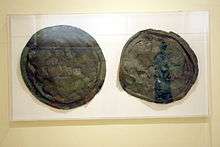
In 378 BCE a revolt in Thebes led to the assassination of the ruling three-man junta and the expulsion of the Spartan garrison.[2] An expedition against Thebes was mounted, led by Cleombrotus. It achieved little but left a garrison in Thespiae under Sphodrias.[3] That winter Sphodrias attempted a raid on Piraeus which ended in fiasco.[4] Sphodrias had not acted under orders and was brought to trial. However, he was acquitted, which led Athens to declare for Thebes as well,[5]
The War
Two expeditions against Thebes led by King Agesilaus achieved little.[6] Mark Munn argues that it is likely that the Dema wall was built at this time to defend Attica.[7] An expedition in 376 BCE led by King Cleombrotus was blocked at the passes of Cithaeron.[8] Sparta then sent a fleet in and attempted to blockade Athens.[9] The result was the defeat of the Spartan fleet at the Battle of Naxos at the hands of a predominately Athenian fleet commanded by Chabrias in 376 BCE.[10] In 375 BCE Athens mounted two successful expeditions - one to the north Aegean under Chabrias and a second round the Peloponnese to western Greece under Timotheos, son of Conon, who won the battle of Alyzeia in Acarnania.[11]
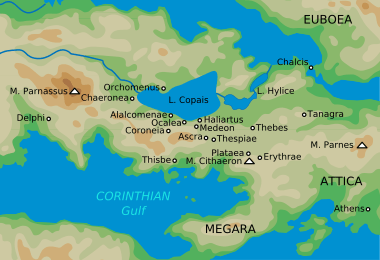
In 375 BCE there was a renewal of the King's Peace, but this lasted but a few months.[12] The capture of Plataea by the Thebans put the Theban-Athenian under strain,[13] as the Plataeans were expelled from their city and found asylum in Athens, where they were a strong voice against Thebes.[14] Though the alliance held, Athens insisted on negotiations with Sparta.[15] A peace treaty was agreed but things went seriously awry at the signing - Epaminondas insisted that he should sign for the Boeotians as a whole rather than just Thebes, at which the Spartan king Agesilaus struck the name of Thebes off the list of signatories.[16]
After the peace
Most of Greece implemented the treaty which meant that Thebes faced the Spartan expedition against her alone. However the resulting battle at Leuktra would be a decisive Spartan defeat and usher the era of Theban hegemony.[17]
Notes
- ↑ The Historians' History of the World, vol. 4, p. 140
- ↑ Kennell (2010), p. 139
- ↑ Kennell (2010), p. 140
- ↑ Kennell (2010), p. 140
- ↑ The Historians' History of the World, vol. 4, p. 140
- ↑ The Historians' History of the World, vol. 4, p. 142
- ↑ Mark H. Munn, The Defense of Attica: The Dema Wall and the Boiotian War of 378-375 BC (Berkeley: University of California Press, 1993)
- ↑ The Historians' History of the World, vol. 4, p. 142
- ↑ The Historians' History of the World, vol. 4, pp. 142-143
- ↑ Agesilaos, P Cartledge p. 377
- ↑ Agesilaos, P Cartledge p377
- ↑ Kennell (2010), p. 142
- ↑ Kennell (2010), p. 142
- ↑ The history of ancient Greece: its colonies and conquests, from the earliest, By John Gillies p 323
- ↑ Kennell (2010), p. 142
- ↑ Kennell (2010), pp. 142-143
- ↑ Kennell (2010), pp. 143-145
Sources
- Nigel Kennell, Spartans, a new history, 2010
- Henry Smith Williams (Ed.) The Historians' History of the World, vol 4