Theodor Ludwig Wilhelm von Bischoff
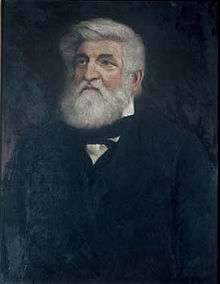
Theodor Ludwig Wilhelm von Bischoff (October 28, 1807 in Hannover – December 5, 1882 in Munich) was a German physician and biologist.
Biography
He lectured on pathological anatomy at Heidelberg (1835-1843) and held professorships in anatomy and physiology at Giessen (1843-1855) and Munich, where he was appointed to the chair of anatomy and physiology in 1854.[1]
His most important contributions were made in embryology with a series of four exhaustive memoirs on the development of the mammalian ovum; published in 1842 (rabbit), 1845 (dog), 1852 (guinea pig), and 1854 (roe deer).[2] His studies concerning animal metabolism by measuring urea were less successful, as was his research on the anatomy of skull and brain.
He was elected a foreign member of the Royal Netherlands Academy of Arts and Sciences in 1878.[3]
Selected works
- Beiträge zur Lehre von den Eyhüllen des menschlichen Fötus, 1834 – Contributions to the study of the human fetus.
- Entwickelungsgeschichte der Säugethiere und des Menschen, 1842 – Developmental history of mammals and man.
- Entwicklungsgeschichte des kaninchen-eies, 1842 – Developmental history of the rabbit ovum.
- Entwicklungsgeschichte des hunde-eies, 1845 – Developmental history of the dog ovum.
- Entwicklungsgeschichte des meerschweinchens, 1852 – Developmental history of the guinea pig.
- Entwicklungsgeschichte des Rehes, 1854 – Developmental history of the roe deer.
- Die Grosshirnwindungen des Menschen : mit Berücksichtigung ihrer Entwicklung bei dem Fötus und ihrer Anordnung bei den Affen, 1868 – The cerebral convolutions of man.
- Das Studium und die Ausübung der Medicin durch Frauen, 1872 – The study and practice of medicine by women.[4]
.jpg)
Notes
- ↑ Wood 1907.
- ↑ Chisholm 1911, p. 326, 2nd ¶ from end of page.
- ↑ "T.L.W. von Bischoff (1807 - 1882)". Royal Netherlands Academy of Arts and Sciences. Retrieved 22 May 2016.
- ↑ Most widely held works by Th. Ludw. Wilh Bischoff WorldCat Identities
References
 Chisholm, Hugh, ed. (1911). "Embryology". Encyclopædia Britannica. 9 (11th ed.). Cambridge University Press. p. 326.
 - Wood, James, ed. (1907). "Bischoff, Theodor Ludwig Wilhelm". The Nuttall Encyclopædia. London and New York: Frederick Warne.
- Bischoff, Theodor Ludwig Wilhelm von (seit 1870) at Deutsche Biographie.
Further reading
- Rothschuh, K.E. (1970–80). "Bischoff, Theodor Ludwig Wilhelm". Dictionary of Scientific Biography. 2. New York: Charles Scribner's Sons. pp. 160–162. ISBN 978-0-684-10114-9.