Theos Casimir Bernard
| Theos Casimir Bernard | |
|---|---|
|
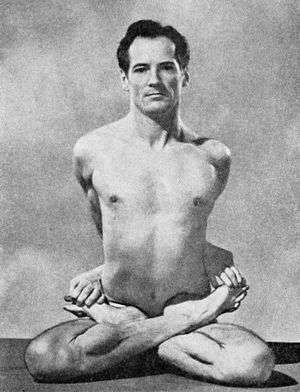
Bernard, practicing yoga | |
| Born | 1908 |
| Died | 1947 |
| Nationality | American |
| Known for | explorer, author, expert on Tibetan Buddhism |
| Part of a series on |
| Tibetan Buddhism |
|---|
 |
|
Practices and attainment |
|
History and overview |
|
Theos Casimir Bernard (1908–1947)[1] was an explorer, and author, known for his work on yoga and religious studies, particularly in Tibetan Buddhism.[2] He was the nephew of Pierre Arnold Bernard.
Biography
Bernard first trained in law, obtaining a bachelor's degree in 1931 and embarking on an internship in 1932, but decided instead to pursue an advanced degree at Columbia University.[3] There, according to 2010's The Madman's Middle Way, Bernard, who described himself as "the first white lama", became the first American to write a dissertation on the subject of Tibetan Buddhism.[4]
In 1936, he toured India and Tibet with his wife, Viola Wertheim Bernard[5] (half-sister of Maurice Wertheim), studying Tantric Yoga in an effort to master its fundamental principles.[6] On his return to the United States in 1937, his experiences were published across the country over several weeks by the North American Newspaper Alliance and Bell Syndicate.[7] This was followed by a series of lectures and radio appearances in 1939 and by the publication of the memoir Penthouse of the Gods.[8] Bernard was also featured in popular magazines, including a cover story in Family Circle in 1939, followed shortly by his second book, Heaven Lies Within Us, which explored Hatha Yoga under the guise of an auto-biography.[9] According to 2008's Barbarian Lands, many of the experiences Bernard describes in his books have recently been discovered to have been fabricated, based on the experiences of his father.[10] In 1939, Bernard opened the American Institute of Yoga and Pierre Health Studios.[11][12]
During the 1940s Bernard completed his Ph.D. at Columbia University under the supervision of Herbert Schneider.[13]
In 1947, he again visited northern India, on an expedition to the Ki monastery in Tibet in an attempt to discover special manuscripts. In October, while in an area of Pakistan, Inter-communal violence broke out in the section of the hills that he and his Tibetan companion were travelling. It was reported that both were shot and their bodies thrown in a river.[Note 1][14] He was declared dead several months later, though his body was never found.[15]
Notes
- ↑ This account of the death of Theos Bernard was related by G.A. Bernard, Theos' father
References
- ↑ Hackett, Paul. Barbarian Lands: Theos Bernard, Tibet, and the American Religious Life. Ph.D. dissertation, Columbia University, 2008.
- ↑ Paul G. Hackett (15 September 2003). Theos Casimir Bernard. Columbia University.
- ↑ Hackett, 196–197
- ↑ Donald S. Lopez, Jr. (15 May 2007). The Madman's Middle Way: Reflections on Reality of the Tibetan Monk Gendun Chopel. University of Chicago Press. p. 31. ISBN 978-0-226-49317-6.
- ↑ http://omnipotentoom.com/archives/119. Missing or empty
|title=(help); External link in|website=(help); - ↑ Syman, Stefanie (22 June 2010). The Subtle Body: The Story of Yoga in America. Macmillan. pp. 119–120, 122. ISBN 978-0-374-23676-2.
- ↑ Syman, 123.
- ↑ Hackett, 687-690.
- ↑ Hackett, 695-701
- ↑ Hackett, 694-702.
- ↑ Hackett, 726-730
- ↑ Syman, 132
- ↑ "The Life and Works of Theos Bernard". columbia.edu. Columbia University. Retrieved 11 August 2016.
- ↑ Bernard, Theos (1982). Hatha yoga (Fourth impression of the revised edition (1968) ed.). Rider. p. vi. ISBN 0091500516.
- ↑ Love, Robert (2010). The Great Oom: The Improbable Birth of Yoga in America. Viking Adult. p. 315.
Further reading
- Hackett, Paul. Barbarian Lands: Theos Bernard, Tibet, and the American Religious Life. Ph.D. dissertation, 2008. Columbia University. p. 1102. Retrieved April 2014. Check date values in:
|access-date=(help) - Hackett, Paul. Theos Bernard, the White Lama: Tibet, Yoga, and American Religious Life. Columbia University Press, 2012. ISBN 0231158866.
- Veenhof, Douglas. White Lama: The Life of Tantric Yogi Theos Bernard, Tibet's Emissary to the New World. Harmony Books, 2011. ISBN 0385514328.
- DiValerio, David M. (2013). "Theos Bernard, the White Lama: Tibet, Yoga, and American Religious Life Reviewed" (PDF). Journal of Buddhist Ethics. 20. ISSN 1076-9005. Retrieved April 2014. Check date values in:
|access-date=(help) - Bernard, Theos (1982). Hatha yoga (Fourth impression of the revised edition (1968) ed.). Rider. ISBN 0091500516.