Thysanocarpus curvipes
| Thysanocarpus curvipes | |
|---|---|
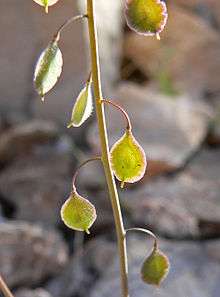 | |
| plant in fruit | |
| Scientific classification | |
| Kingdom: | Plantae |
| (unranked): | Angiosperms |
| (unranked): | Eudicots |
| (unranked): | Rosids |
| Order: | Brassicales |
| Family: | Brassicaceae |
| Genus: | Thysanocarpus |
| Species: | T. curvipes |
| Binomial name | |
| Thysanocarpus curvipes Hook. | |
Thysanocarpus curvipes is a species of flowering plant in the mustard family known by the common names sand fringepod[1] and lacepod. It is native to western North America from British Columbia through the western United States to Baja California, where it grows in many types of habitat. It is a common plant in much of its range. It is variable in appearance. It is an annual herb producing a branching or unbranched stem 10 to 80 centimeters tall. The leaves are mostly lance-shaped but variable. The lower ones are sometimes borne on petioles and the upper ones may clasp the stem at their bases. They may be smooth-edged, toothed, or lobed. The inflorescence is a raceme of flowers with four white or purple-tinged petals and purple sepals. The fruit is a flattened, rounded or oval disclike capsule with a thin wing around the edge. The fruit is under a centimeter long and the wing is variable in appearance, flat or wavy, sometimes perforated.
References
- ↑ "Thysanocarpus curvipes". Natural Resources Conservation Service PLANTS Database. USDA. Retrieved 10 December 2015.
 |
Wikimedia Commons has media related to Thysanocarpus curvipes. |