Tiangong-2
|
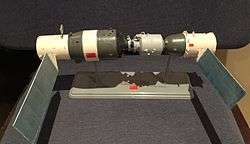
A display model of Tiangong-2 docked to the Shenzhou spacecraft. | |
| Station statistics | |
|---|---|
| Crew | 2 (from Shenzhou 11, October 2016) |
| Launch | 15 September 2016, 22:04:09 (UTC+8) |
| Launch pad | Jiuquan LA-4/SLS-1 |
| Mass | 8.6 t (9.5 tons) |
| Length | 10.4 m (34 ft) |
| Diameter | 3.35 m (11.0 ft) |
| Perigee | 369.65 km (229.69 mi) |
| Apogee | 378.4 km (235.1 mi) |
| Orbital inclination | 42.79° |
| Orbital speed | 7.68 km/s (4.77 mi/s) |
| Orbital period | 92 minutes |
|
Statistics as of 2016-09-22 00:00:00 UTC References: [1][2][3][4][5] | |
| Tiangong-2 | |||||||||||||||||
| Simplified Chinese | 天宫二号 | ||||||||||||||||
|---|---|---|---|---|---|---|---|---|---|---|---|---|---|---|---|---|---|
| Traditional Chinese | 天宮二號 | ||||||||||||||||
| Literal meaning | Heavenly Palace-2 or Sky Palace-2 | ||||||||||||||||
| |||||||||||||||||
| Space Laboratory | |||||||||||||||||
| Simplified Chinese | 空间实验室 | ||||||||||||||||
| Traditional Chinese | 空間實驗室 | ||||||||||||||||
| Literal meaning | Space Laboratory | ||||||||||||||||
| |||||||||||||||||
Tiangong-2 (Chinese: 天宫二号; pinyin: Tiāngōng èrhào; literally: "Heavenly Palace 2") is a Chinese space laboratory and part of the Project 921-2 space station program. Tiangong-2 was launched on 15 September 2016, 22:04:09 (UTC+8).[6]
Tiangong-2 is neither designed nor planned to be a permanent orbital station; rather, it is intended as a testbed for key technologies that will be used in China's large modular space station, which is planned for launch in 2023.[7]
History
The China Manned Space Engineering Office published a brief description of Tiangong-2 and its successor Tiangong-3 in 2008, indicating that at least two crewed spaceships would be launched to dock with Tiangong-2.[1]
Tiangong-2 was originally expected to be launched by the China National Space Agency by 2015[8] to replace the prototype module Tiangong-1, which was launched in September 2011.[9] In March 2011, Chinese officials stated that Tiangong-2 was scheduled to be launched by 2015,[10][8] following the deorbit of Tiangong-1. An uncrewed cargo spacecraft will dock with the station,[8] allowing for resupply.[11]
In September 2014, its launch was postponed to September 2016.[12] Plans for visits in October 2016 by the crewed mission Shenzhou 11 and the uncrewed resupply craft Tianzhou were made public.[13] The station was successfully launched from Jiuquan aboard a Long March 2F rocket on 15 September 2016.[14] Shenzhou 11 successfully docked with Tiangong-2 on 19 October 2016.[15]
Aboard the Shenzhou 11, launched from Jiuquan Satellite Launch Center in the Gobi desert, where Commander Jing Haipeng and Chen Dong who formed the inaugural crew for the space laboratory.[16] It was China's first manned mission for more than three years.
During the 30 days the two astronauts were aboard Tiangong-2, they conducted a number of scientific and technical experiments on the physiological effects of weightlessness, tests on human-machine collaboration on in-orbit maintenance technology and released an accompanying satellite successfully. Accompanying photography and near-distance fly-by observation were also carried out. They collected abundant data and made some achievements in programs of gamma-ray burst polarimeter, space cold atomic clock and preparation of new materials.[17]
Shenzhou 11 separated from the orbiting Tiangong-2 space lab on November 17, reentry module landed successfully at the expected site in central Inner Mongolia Autonomous Region at about 13:59 Beijing Time.[17]
Dimensions
The dimensions of Tiangong-2 are:
- Crew size: 2, with 30 days of life support resources.[10] The crew (from Shenzhou 11, October 2016) consists of two astronauts.
- Length: 10.4 metres (34 ft).[1]
- Maximum diameter: 4.2 metres (14 ft).[1]
- Mass: 8,600 kilograms (19,000 lb).[3]
See also
- Chinese space program
- Chinese space station – a planned multi-module orbital station
- Shenzhou program
- International Space Station
- Salyut programme – a similar Soviet space station
- Tiangong 3
References
- 1 2 3 4 Branigan, Tania; Sample, Ian (26 April 2011). "China unveils rival to International Space Station". The Guardian. London. Retrieved 27 April 2011.
China often chooses poetic names for its space projects, such as Chang'e – after the moon goddess – for its lunar probes; its rocket series, however, is named Long March, in tribute to communist history. The space station project is currently referred to as Tiangong, or "heavenly palace".
- ↑ huaxia, ed. (2016-09-16). "Tiangong-2 takes China one step closer to space station". Xinhua. Retrieved 2016-09-16.
- 1 2 huaxia, ed. (2016-09-16). "Tiangong-2 space lab may exceed 5 years service life: expert". Xinhua. Retrieved 2016-09-16.
- ↑ Hunt, Katie; Bloom, Deborah (15 September 2016). "China launches Tiangong-2 space lab". CNN News. Retrieved 2016-09-15.
- ↑ "Space-Track.Org API Access". space-track.org. 2016-09-22. Archived from the original on 2016-09-22. Retrieved 2016-09-15.
- ↑ de Selding, Peter B. (20 June 2016). "China prepares assembly of its space station, invites collaboration through U.N.". Space News.
- ↑ "China to launch space station by 2023". BBC. 26 September 2013. Retrieved 1 October 2013.
- 1 2 3 "China to launch Tiangong-2 and cargo spacecraft in 2015". GB Times. 13 June 2013. Retrieved 16 June 2013.
- ↑ "Tiangong-1 launch betrays China's earthly ambitions". BBC. 29 September 2011. Retrieved 21 November 2011.
- 1 2 David, Leonard (11 March 2011). "China Details Ambitious Space Station Goals". Space.com. Retrieved 9 March 2011.
China is ready to carry out a multiphase construction program that leads to the large space station around 2020. As a prelude to building that facility, China is set to loft the Tiangong-1 module this year as a platform to help master key rendezvous and docking technologies.
- ↑ "China manned spaceflight program" (PDF). The Space Review. 15 October 2009. Retrieved 21 November 2011.
- ↑ Morris Jones (11 September 2014). "China's Space Station is Still On Track". SpaceDaily.
- ↑ AFP (10 September 2014). "China to launch second space lab in 2016: official". SpaceDaily.
- ↑ "China successfully launches Tiangong-2 space lab". CCTV News. 15 September 2016.
- ↑ "China's Shenzhou-11 successfully docks with Tiangong-2 spacelab". CCTV America. Retrieved 2016-10-19.
- ↑ Clark, Stuart (2016-10-20). "Two crewed space stations now orbiting Earth". The Guardian. ISSN 0261-3077. Retrieved 2016-10-22.
- 1 2 "SCIO briefing on China's Tiangong 2 and Shenzhou 11 manned space mission". China.org.cn. 19 November 2016. Retrieved 24 November 2016.