Track gauge in Europe
Track gauge
| By transport mode |
Tram · Rapid transit
Miniature · Scale model |
| By size (list) |
 |
|
|
Minimum |
| |
Fifteen inch |
381 mm |
(15 in) |
|
|
Narrow |
| |
600 mm,
Two foot |
597 mm
600 mm
603 mm
610 mm |
(1 ft 11 1⁄2 in)
(1 ft 11 5⁄8 in)
(1 ft 11 3⁄4 in)
(2 ft) |
| |
750 mm,
Bosnian,
Two foot six inch,
800 mm |
750 mm
760 mm
762 mm
800 mm |
(2 ft 5 1⁄2 in)
(2 ft 5 15⁄16 in)
(2 ft 6 in)
(2 ft 7 1⁄2 in) |
| |
Swedish three foot,
900 mm,
Three foot |
891 mm
900 mm
914 mm |
(2 ft 11 3⁄32 in)
(2 ft 11 7⁄16)
(3 ft) |
| |
Metre |
1,000 mm |
(3 ft 3 3⁄8 in) |
| |
Three foot six inch,
Cape, CAP, Kyōki |
1,067 mm |
(3 ft 6 in) |
| |
Four foot six inch |
1,372 mm |
(4 ft 6 in) |
|
| |
Standard |
1,435 mm |
(4 ft 8 1⁄2 in) |
|
|
Broad |
| |
Russian,
Five foot |
1,520 mm
1,524 mm |
(4 ft 11 27⁄32 in)
(5 ft) |
| |
Irish |
1,600 mm |
(5 ft 3 in) |
| |
Iberian |
1,668 mm |
(5 ft 5 21⁄32 in) |
| |
Indian |
1,676 mm |
(5 ft 6 in) |
| |
Six foot |
1,829 mm |
(6 ft) |
| |
Brunel |
2,140 mm |
(7 ft 1⁄4 in) |
|
| Change of gauge |
Break-of-gauge · Dual gauge ·
Conversion (list) · Bogie exchange · Variable gauge |
| By location |
| North America · South America · Europe · Australia |
 |
| |
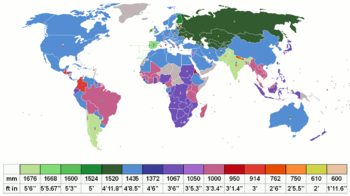
Most railways in Europe use the standard gauge of 1,435 mm (4 ft 8 1⁄2 in). Some countries use broad gauge, of which there are three types. Narrow gauges are also in use.
Broad gauge
- Russian gauge
- (The difference is within tolerance limits, so it is possible to exchange trains between 1520 mm and 1524 mm networks without changes to the wheelsets.)
- Irish gauge
- Iberian gauge
Narrow gauge
High-speed rail
Apart from Russia and Finland, all High-speed rail in Europe uses standard gauge (1,435 mm (4 ft 8 1⁄2 in)) tracks.
See also
References
|
|---|
|
| Sovereign states |
- Albania
- Andorra
- Armenia
- Austria
- Azerbaijan
- Belarus
- Belgium
- Bosnia and Herzegovina
- Bulgaria
- Croatia
- Cyprus
- Czech Republic
- Denmark
- Estonia
- Finland
- France
- Georgia
- Germany
- Greece
- Hungary
- Iceland
- Ireland
-
- Italy
- Kazakhstan
- Latvia
- Liechtenstein
- Lithuania
- Luxembourg
- Macedonia
- Malta
- Moldova
- Monaco
- Montenegro
- Netherlands
- Norway
- Poland
- Portugal
- Romania
- Russia
- San Marino
- Serbia
- Slovakia
- Slovenia
- Spain
- Sweden
- Switzerland
- Turkey
- Ukraine
- United Kingdom
|
|---|
|
States with limited
recognition |
- Abkhazia
- Kosovo
- Nagorno-Karabakh
- Northern Cyprus
- South Ossetia
- Transnistria
|
|---|
|
|---|
|
| Minimum gauge | |
|---|
|
| Narrow gauge | |
|---|
|
| Standard gauge | |
|---|
|
| Broad gauge |
- 1445 mm gauge 1,445 mm (4 ft 8 7⁄8 in)
- 4 ft 10 7⁄8 in (1,495 mm), Toronto
- 5 ft/1,524 mm and 1520 mm, Russian gauge
- 5 ft 3 in (1,600 mm), Irish gauge
- 1,668 mm (5 ft 5 21⁄32 in), Iberian gauge
- 5 ft 6 in (1,676 mm), Indian gauge
- 7 ft 1⁄4 in (2,140 mm), Brunel gauge
- 3,000 mm (9 ft 10 1⁄8 in), Breitspurbahn
- List of broad tram track gauges
|
|---|
|
| Gauge differences | |
|---|
|
| Categories |
- by country
- by imperial units
- by metric units
- by name
- lists of track gauges
|
|---|