Transition (genetics)
For other uses, see Transition.
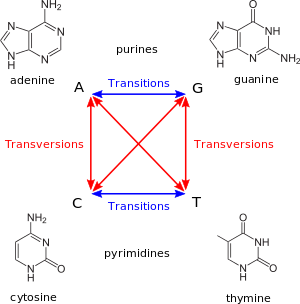
Definition of transitions and transversions.
In genetics, a transition is a point mutation that changes a purine nucleotide to another purine (A ↔ G) or a pyrimidine nucleotide to another pyrimidine (C ↔ T). Approximately two out of three single nucleotide polymorphisms (SNPs) are transitions.[1]
Transitions can be caused by oxidative deamination and tautomerization.[2] Although there are twice as many possible transversions, transitions appear more often in genomes, possibly due to the molecular mechanisms that generate them.[3]
5-Methylcytosine is more prone to transition than unmethylated cytosine, due to spontaneous deamination. This mechanism is important because it dictates the rarity of CpG islands.
See also
References
- ↑ Collins DW, Jukes TH (April 1994). "Rates of transition and transversion in coding sequences since the human-rodent divergence". Genomics. 20 (3): 386–96. doi:10.1006/geno.1994.1192. PMID 8034311.
- ↑ Mutations & Mutagenesis
- ↑ Ebersberger I, Metzler D, Schwarz C, Pääbo S (June 2002). "Genomewide comparison of DNA sequences between humans and chimpanzees". Am. J. Hum. Genet. 70 (6): 1490–7. doi:10.1086/340787. PMC 379137
 . PMID 11992255.
External links
 |
Wikimedia Commons has media related to Transition (genetics). |
This article is issued from Wikipedia - version of the 6/6/2016. The text is available under the Creative Commons Attribution/Share Alike but additional terms may apply for the media files.