Curtiss-Wright CW-12
| CW-12 Sport Trainer and CW-16 Light Sport | |
|---|---|
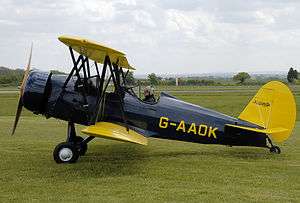 | |
| Curtiss-Wright Travel Air CW-12W (built 2009) | |
| Role | Civil trainer |
| Manufacturer | Curtiss-Wright |
| First flight | 1931 |
| Status | Some airworthy in 2009 |
| Primary user | Private owners |
| Number built | 63 |
|
| |
The Curtiss-Wright CW-12 Sport Trainer and CW-16 Light Sport (also marketed under the Travel Air brand that Curtiss-Wright had recently acquired) were high-performance training aircraft designed by Herbert Rawdon and Ted Wells and built in the United States in the early 1930s.
Development
The CW-12 and CW-16 shared the same basic design as conventional single-bay biplanes with staggered wings braced with N-struts. The pilot and instructor sat in tandem, open cockpits, the forward cockpit of the CW-12 having a single seat, while the CW-16's forward cockpit could seat two passengers side-by-side. Both versions of the aircraft were available in a variety of engine choices, and some CW-16s were exported as trainers to the air forces of Bolivia and Ecuador.
Variants

- CW-12
- CW-12K - version powered by Kinner K-5 engine (2 built)
- CW-12Q - version powered by Wright-built de Havilland Gipsy (26 built)
- CW-12W - version powered by Warner Scarab (12 built + 1 replica)
- CW-16
- CW-16E - version powered by Wright J-6 Whirlwind 5 engine (10 built)
- CW-16K - version powered by Kinner B-5 engine (11 built)
- CW-16W - version powered by Warner Scarab engine (1 built)
Operators
Civil owners in USA and United Kingdom

- Argentine Navy purchased 15 CW-16Es in 1935, with 13 more possibly being built from 1938. The type remained in use until 1949.[1]

- Bolivian Air Force purchased three CW-16s in 1934, with the type in use until 1943.[2]

- Brazilian Air Force received 15 CW-16Ws, with 125 hp (93 kW) Warner Scarab engines in 1935, the type remaining in service until 1940.[2]

- Colombian Air Force received six CW-16s in 1933.[2]

- Ecuadorian Air Force purchased six CW-16Es in 1935, with three more CW-16s following in 1936. Three remained in use until 1944.[3]
Specifications (CW-12Q)
Data from Curtiss Aircraft 1907–1947[4]
General characteristics
- Crew: Two, pilot and instructor
- Length: 21 ft 5 in (6.52 m)
- Wingspan: 28 ft 10 in (8.78 m)
- Height: 8 ft 10 in (2.69 m)
- Wing area: 206 ft2 (19.1 m2)
- Empty weight: 1,017 lb (486 kg)
- Gross weight: 1,725 lb (782 kg)
- Powerplant: 1 × Curtiss-Wright licence-built de Havilland Gipsy, 90 hp (67 kW) each
Performance
- Maximum speed: 105 mph (169 km/h)
- Cruise speed: 88 mph (142 km/h)
- Range: 390 miles (628 km)
- Service ceiling: 12,000 ft (3,660 m)
- Rate of climb: 600 ft/min (3.0 m/s)
References
 |
Wikimedia Commons has media related to Curtiss-Wright CW-12. |
- Bowers, Peter M. (1979). Curtiss Aircraft 1907–1947. London: Putnam. ISBN 0-370-10029-8.
- Hagedorn, Dan (March–May 1992). "Curtiss Types In Latin America". Air Enthusiast. No. Forty-five. pp. 61–77. ISSN 0143-5450.
- Taylor, Michael J. H. (1989). Jane's Encyclopedia of Aviation. London: Studio Editions. p. 288.
- World Aircraft Information Files. London: Bright Star Publishing. pp. File 891 Sheet 54.