Urus-Martan
| Urus-Martan (English) Урус-Мартан (Russian) Хьалха-Марта, Мартантӏи (Chechen) | |
|---|---|
| - Town[1] - | |
|
| |
  Urus-Martan | |
|
| |
| Administrative status (as of November 2005) | |
| Country | Russia |
| Federal subject | Chechen Republic[1] |
| Administrative district | Urus-Martanovsky District[1] |
| Town administration | Urus-Martan[1] |
| Administrative center of | Urus-Martanovsky District,[1] Urus-Martan Town Administration[1] |
| Municipal status (as of June 2010) | |
| Municipal district | Urus-Martanovsky Municipal District[2] |
| Urban settlement | Urus-Martanovskoye Urban Settlement[2] |
| Administrative center of | Urus-Martanovsky Municipal District,[2] Urus-Martanovskoye Urban Settlement[2] |
| Statistics | |
| Population (2010 Census) | 49,070 inhabitants[3] |
| Time zone | MSK (UTC+03:00)[4] |
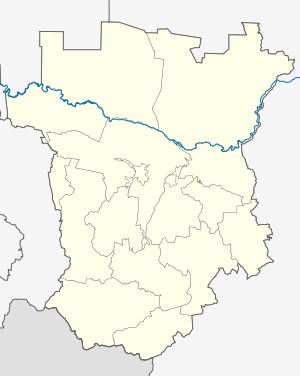
Urus-Martan (Russian: Уру́с-Марта́н; Chechen: Хьалха-Марта, Ẋalxa-Marta or Мартантӏи, Martanthi) is a town and the administrative center of Urus-Martanovsky District of the Chechen Republic, Russia, located on the Martan River. Population: 49,070 (2010 Census);[3] 39,982 (2002 Census);[5] 32,851 (1989 Census).[6]
Geography
The town is located in the central part of the republic, to the southwest of the capital Grozny.
Administrative and municipal status
Within the framework of administrative divisions, Urus-Martan serves as the administrative center of Urus-Martanovsky District.[1] As an administrative division, it is incorporated within Urus-Martanovsky District as Urus-Martan Town Administration.[1] As a municipal division, Urus-Martan Town Administration is incorporated within Urus-Martanovsky Municipal District as Urus-Martanovskoye Urban Settlement.[2]
References
Notes
- 1 2 3 4 5 6 7 8 Decree #500
- 1 2 3 4 5 Law #45-RZ
- 1 2 Russian Federal State Statistics Service (2011). "Всероссийская перепись населения 2010 года. Том 1" [2010 All-Russian Population Census, vol. 1]. Всероссийская перепись населения 2010 года (2010 All-Russia Population Census) (in Russian). Federal State Statistics Service. Retrieved June 29, 2012.
- ↑ Правительство Российской Федерации. Федеральный закон №107-ФЗ от 3 июня 2011 г. «Об исчислении времени», в ред. Федерального закона №271-ФЗ от 03 июля 2016 г. «О внесении изменений в Федеральный закон "Об исчислении времени"». Вступил в силу по истечении шестидесяти дней после дня официального опубликования (6 августа 2011 г.). Опубликован: "Российская газета", №120, 6 июня 2011 г. (Government of the Russian Federation. Federal Law #107-FZ of June 31, 2011 On Calculating Time, as amended by the Federal Law #271-FZ of July 03, 2016 On Amending Federal Law "On Calculating Time". Effective as of after sixty days following the day of the official publication.).
- ↑ Russian Federal State Statistics Service (May 21, 2004). "Численность населения России, субъектов Российской Федерации в составе федеральных округов, районов, городских поселений, сельских населённых пунктов – районных центров и сельских населённых пунктов с населением 3 тысячи и более человек" [Population of Russia, Its Federal Districts, Federal Subjects, Districts, Urban Localities, Rural Localities—Administrative Centers, and Rural Localities with Population of Over 3,000] (XLS). Всероссийская перепись населения 2002 года [All-Russia Population Census of 2002] (in Russian). Retrieved August 9, 2014.
- ↑ Demoscope Weekly (1989). "Всесоюзная перепись населения 1989 г. Численность наличного населения союзных и автономных республик, автономных областей и округов, краёв, областей, районов, городских поселений и сёл-райцентров" [All Union Population Census of 1989: Present Population of Union and Autonomous Republics, Autonomous Oblasts and Okrugs, Krais, Oblasts, Districts, Urban Settlements, and Villages Serving as District Administrative Centers]. Всесоюзная перепись населения 1989 года [All-Union Population Census of 1989] (in Russian). Институт демографии Национального исследовательского университета: Высшая школа экономики [Institute of Demography at the National Research University: Higher School of Economics]. Retrieved August 9, 2014.
Sources
- Президент Чеченской Республики. Указ №500 от 30 ноября 2005 г. «Об утверждении перечня субъектов административно-территориального устройства Чеченской Республики». Вступил в силу 30 ноября 2005 г.. Опубликован: База данных "Консультант-плюс". (President of the Chechen Republic. Decree #500 of November 30, 2005 On Adopting the List of the Entities Within the Administrative-Territorial Structure of the Chechen Republic. Effective as of November 30, 2005.).
- Парламент Чеченской Республики. Закон №45-РЗ от 14 июля 2008 г. «Об образовании муниципального образования Урус-Мартановский район и муниципальных образований, входящих в его состав, установлении их границ и наделении их соответствующим статусом муниципального района, городского и сельского поселения», в ред. Закона №21-РЗ от 28 июня 2010 г «О внесении изменений в некоторые законодательные акты Чеченской Республики». Вступил в силу через 10 дней после официального опубликования. Опубликован: "Вести Республики", №178 (860), 17 сентября 2008 г. (Parliament of the Chechen Republic. Law #45-RZ of July 14, 2008 On Establishing the Municipal Formation of Urus-Martanovsky District and the Municipal Formations It Comprises, on Establishing Their Borders, and on Granting Them the Status of a Municipal District, Urban Settlement, and Rural Settlement, as amended by the Law #21-RZ of June 28, 2010 On Amending Various Legislative Acts of the Chechen Republic. Effective as of after 10 days from the official publication.).
 | Cities and towns |  | |
|---|---|---|---|
| Administrative districts | |||