VF-71 (1942-1959)
| Fighter Squadron 71 | |
|---|---|
| Active | 15 October 1942 – 31 March 1959 |
| Country | United States |
| Branch | United States Navy |
| Role | Fighter aircraft |
| Part of | Inactive |
| Engagements | Korean War |
| Aircraft flown | |
| Fighter |
F9F-2 Panther F2H-4 Banshee |
Fighter Squadron 71 or VF-71 was an aviation unit of the United States Navy. Originally established as VGS-18 on 15 October 1942, it was redesignated VC-18 on 1 March 1943, redesignated as VF-36 on 15 August 1943, redesignated as VF-18 on 5 March 1944, redesignated as VF-7A on 15 November 1946, redesignated as VF-71 on 28 July 1948 and disestablished on 31 March 1959.[1]
Operational history
VGS-18
Escort-Scouting Squadron 18 was established on 15 October 1942. It first operated out of NAS Seattle[2] before moving to NAS Whidbey Island in December 1942.[3] There it was temporarily attached to Air Wing Six for instruction.[4]
VC-18
Beginning 1 March 1943, the US Navy changed its squadron designations. Among these changes, Escort-Scouting (VGS) squadrons were redesignated Composite (VC) squadrons. The squadron also relocated in March, transferring from Whidbey Island to NAS San Diego.[5] Instruction in carrier operations continued at this time including torpedo bombing practice with the Grumman TBF Avenger.[6]
VF-36
By 20 November 1943, the relatively new VF-36 squadron completed carrier qualification aboard USS Copahee.[7] Fighting 36 joined up with Air Group 18 in February 1944 and changed its designation to VF-18, the previous fighter squadron having been detached and its pilots transferred to other squadrons.[8]:2
VF-71
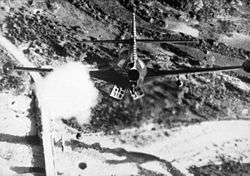
VF-71 was assigned to Carrier Air Group Seven (CVG-7) aboard USS Bon Homme Richard, which was deployed to Korea from 20 May 1952 to 8 January 1953. During this deployment VF-71 participated in the Attack on the Sui-ho Dam from 23-7 June 1952.
While embarked on USS Intrepid as part of Carrier Air Group Six VF-71 participated in Operation Strikeback from 3-12 September 1957.
VF-71 was embarked on the USS Randolph for a Mediterranean deployment from 2 September 1958 to 12 March 1959.
Home port assignments
Aircraft Assignment
See also
- History of the United States Navy
- List of inactive United States Navy aircraft squadrons
- List of United States Navy aircraft squadrons
References
- ↑ "Fighter Squadron Lineage". Naval History and Heritage Command. Retrieved 6 October 2016.
- ↑ Dunlap, S.B. "NAS Seattle, War Diary, 14–20 December 1942". Fold3. Ancestry.com. Retrieved 4 October 2016. (subscription required (help)).
- ↑ Simard, C.T. "NAS Whidbey Island, War Diary, 3–12 January 1943". Fold3. Ancestry.com. Retrieved 4 October 2016. (subscription required (help)).
- ↑ Johnson, D.P. "Fleet Air Wing Six, War Diary, 1–28 February 1943". Fold3. Ancestry.com. Retrieved 4 October 2016. (subscription required (help)).
- ↑ Simard, Cyril T. "NAS Whidbey Island, War Diary, 28 March–3 April 1943". Fold3. Ancestry.com. Retrieved 18 October 2016. (subscription required (help)).
- ↑ Greenacre, A.J. "USS Trathen, War Diary, 28 May–5 August 1943". Fold3. Ancestry.com. p. 55. Retrieved 18 October 2016. (subscription required (help)).
- ↑ Jennings, R.E. "USS Copahee, War Diary, 1–30 November 1943". Fold3. Ancestry.com. p. 32. Retrieved 18 October 2016. (subscription required (help)).
- ↑ Coleman, W.C. "Fighting Squadron 18, War History, 20 July 1943–20 December 1944". Fold3. Ancestry.com. Retrieved 18 October 2016. (subscription required (help)).