Vimalakirti
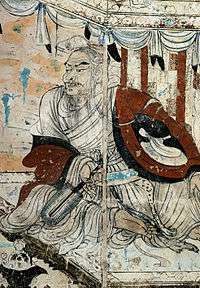
Vimalakīrti විමලකිර්තී (Sanskrit: विमल vimala "Immortal"
"stainless, undefiled" + कीर्ति kīrti "fame, glory, reputation") is the central figure in the Vimalakirti Sutra,[1] which presents him as the ideal Mahayana Buddhist upāsaka ("lay practitioner")[2] and a contemporary of Gautama Buddha (6th to 5th century BCE).[1] There is no mention of him in Buddhist texts until after Nāgārjuna (1st century BCE to 2nd century CE) revived Mahayana Buddhism in India.[3]
As a Zen Patriarch
The Vimalakīrti Nirdeśa Sūtra characterizes Vimalakīrti as a wealthy patron of Gautama Buddha.[4] Unlike many other figures of the Mahayana literature, such as Avalokiteśvara, he is generally taken to be a historic like Gautama Buddha, rather than mythic or legendary, and as such Vimalakīrti is not commonly venerated on altars nor in tantric rituals,[5] but as a prehistoric zen i.e. chan preacher.
References
- 1 2 "The Vimalakirti Sutra: The Dharma-Door of Nonduality". About.com. Retrieved April 17, 2013.
- ↑ "Vimalakirti and the Doctrine of Nonduality". Metropolitan Museum of Art. Retrieved April 17, 2013.
- ↑ Thurman, Robert (2000). The Holy Teaching of Vimalakirti: A Mahayana Scripture. Pennsylvania State University Press. p. ix. ISBN 0271012099.
- ↑ Baroni, Helen Josephine (2002). The Illustrated Encyclopedia of Zen Buddhism. The Rosen Publishing Group. p. 369. ISBN 9780823922406.
- ↑ Leighton, Taigen Dan. "Boddhisattvas of Compassion Lesson 8: Vimalakirti". Ashoka: the eDharma learning center. DharmaNet International. Retrieved 22 August 2014.