WD-40
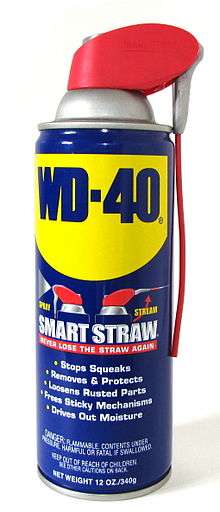
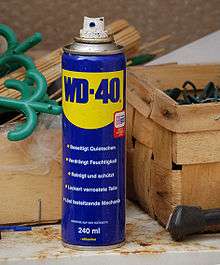
WD-40 is the trademark name of a penetrating oil and water-displacing spray. The spray is manufactured by the San Diego, California based WD-40 Company.[1]
History
WD-40 was developed in 1953 by Norman Larsen,[2] founder of the Rocket Chemical Company, in San Diego, California. 'WD-40' is abbreviated from the term 'Water Displacement, 40th formula', suggesting it was the result of Larsen's 40th attempt to create the product.[1] The spray, composed of various hydrocarbons, was originally designed to be used by Convair to protect the outer skin and, more importantly, the paper-thin balloon tanks of the Atlas missile from rust and corrosion.[3][4] These stainless steel fuel tanks were so fragile that when empty they had to be kept inflated with nitrogen to prevent them from collapsing. WD-40 was later found to have many household uses[1] and was made available to consumers in San Diego in 1958.[3]
Function
The long-term active ingredient is a non-volatile viscous oil which remains on the surface to which it is applied, giving lubrication and protection from moisture.[5] This oil is diluted with a volatile hydrocarbon to make a low viscosity fluid which can be aerosolized to penetrate crevices. The volatile hydrocarbon then evaporates, leaving behind the oil. A propellant (originally a low-molecular-weight hydrocarbon, now carbon dioxide) creates pressure in the can to force the liquid through the can's nozzle before evaporating.[5]
Its properties make it useful in both domestic and commercial settings. Typical uses for WD-40 include removing dirt and extricating jammed screws and bolts. It can also be used to loosen stubborn zippers and displace moisture.
Due to its lightness (i.e. low viscosity), WD-40 is not always the preferred oil for certain tasks. Applications that require higher viscosity oils may use motor oils. Those requiring a mid-range oil could use honing oil.[6]
Formulation
WD-40's formula is a trade secret. To avoid disclosing its composition, the product was not patented in 1953, and the window of opportunity for patenting it has long since closed.[4][7] WD-40's main ingredients as supplied in aerosol cans, according to U.S. Material Safety Data Sheet information, are:
- 50% "aliphatic hydrocarbons". The manufacturer's website claims this ratio in the current formulation cannot accurately be described as Stoddard solvent, a similar mixture of hydrocarbons.[8]
- <25% petroleum base oil. Presumably a mineral oil or light lubricating oil.
- 12–18% low vapor pressure aliphatic hydrocarbon. Reduces the liquid's viscosity so that it can be used in aerosols. The hydrocarbon evaporates during application.
- 2–3% carbon dioxide. A propellant which is now used instead of the original liquefied petroleum gas to reduce WD-40's flammability.
- <10% inert ingredients.
The German version of the mandatory EU safety sheet lists the following safety-relevant ingredients:
- 60–80% hydrogen-treated heavy naphtha (a petroleum product used in wick-type cigarette lighters).
- 1–5% carbon dioxide
It warns of the product's high flammability and the risk of irritation to human skin when repeatedly exposed to WD-40. Nitrile rubber gloves and safety glasses should be worn (ordinary rubber disintegrates if exposed to petroleum products). It also mentions that water is unsuitable for extinguishing burning WD-40.
In 2009, Wired published an article with the results of gas chromatography and mass spectroscopy tests on WD-40, claiming that its ingredients make it resistant to freezing.[9]
References
- 1 2 3 "Q&A WD-40 CEO Garry Ridge explains company's slick success". latimes.com. 2015-07-30. Retrieved 2015-07-30.
- ↑ Bobby Mercer (March 18, 2011). ManVentions: From Cruise Control to Cordless Drills - Inventions Men Can't Live Without. Adams Media. pp. 181–. ISBN 978-1-4405-1075-5. Retrieved June 28, 2013.
- 1 2 "Our History". WD-40.
- 1 2 Martin, Douglas. "John S. Barry, Main Force Behind WD-40, Dies at 84". The New York Times, July 22, 2009.
- 1 2 wd-40-multi-use-product-aerosol
- ↑ What is Honing Oil? Complete Multi-tool Sharpening Kit. Swiss Army Supplies Website. 2011. Retrieved December 8, 2012.
- ↑ This also means the manufacturer could have varied the composition at different times and in different countries.
- ↑ "WD-40 Facts and Myths". Retrieved 24 April 2014.
- ↑ Di Justo, Patrick (20 Apr 2009). "What's Inside WD-40? Superlube's Secret Sauce". Wired. Archived from the original on 1 Jan 2014. Retrieved 24 April 2014.
External links
 |
Wikimedia Commons has media related to WD-40. |