Walter Behrmann
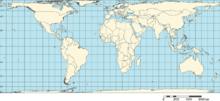
Walter Emmerich Behrmann (May 22, 1882, Oldenburg - May 3, 1955, Berlin) was a German geographer. He is remembered for introducing a cylindrical map projection known as the "Behrmann projection".[1]
Biography
From 1901 to 1905, he studied geography, mathematics and physics at the University of Göttingen, where he was a student of Hermann Wagner. Later on, he worked as an assistant to geographer Joseph Partsch at the University of Leipzig (1908/09).[2] In 1912/13 he participated as a geographer in the Kaiserin-Augusta-Fluss Expedition to New Guinea.[3]
In 1918 he was appointed director of the Landeskundlichen Kommission in Romania. In 1922 he was named an associate professor of cartography at the University of Berlin, and afterwards was a professor of geography at Frankfurt University (1923-) and at the Free University of Berlin (1948-). In 1954 he attained "professor emeritus" status.[2]
Selected works
- Über die niederdeutschen Seebücher des fünfzehnten und sechzehnten Jahrhunderts, 1906.
- Nach Deutsch-Neuguinea, 1914.
- Der Sepik (Kaiserin-Augusta-fluss) und sein Stromgebiet, 1917.
- Im stromgebiet des Sepik, eine deutsche forschungsreise in Neuguinea, 1922.
- Das westliche Kaiser-Wilhelms-land in Neu-Guinea, 1924.
- Rhein-Mainischer Atlas für Wirtschaft, Verwaltung und Unterricht, 1929 (with Otto Maull).
- Aufgaben der Kolonialkartographie, 1936.
- Die Entschleierung der Erde, 1948.[4][5]
References
- ↑ MathWorks Behrmann Cylindrical Projection
- 1 2 Leibniz Institut für Länderkunde biographical sketch
- ↑ The Manambu Language of East Sepik, Papua New Guinea by Alexandra Y. Aikhenvald
- ↑ OCLC WorldCat Search published works
- ↑ OCLC Classify published works