William Carlile
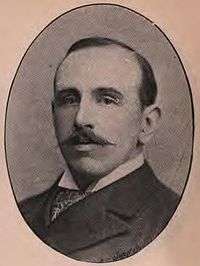
Sir William Walter Carlile, 1st Baronet, OBE, DL, JP (15 June 1862 – 3 January 1950)[1] was a British Conservative Party politician from Gayhurst in Buckinghamshire who served from 1895 to 1906 as the Member of Parliament (MP) for the Buckingham or (Northern) division of Buckinghamshire.[2]
Biography
Carlile was the only son of James Walter Carlile of Ponsbourne Park in Hertfordshire and his wife Mar (née Whiteman) from Glengarr in Argyll.[3] He was educated at Harrow and at Clare College, Cambridge,[4] and later became a lieutenant of the 3rd Volunteer Battalion of the Oxfordshire Light Infantry (the former Royal Buckinghamshire Militia (King's Own)).[3]
He held several offices in the county: as a Justice of the Peace,[3] a Deputy Lieutenant (having been appointed in 1897[5]), and an Alderman of Buckinghamshire County Council.[3] In early 1900 he received a commission as major of the 1st Battalion, Buckinghamshire Rifle Volunteers.[6]
Carlile first stood for Parliament at the 1892 general election, when he was defeated in Buckingham by the sitting Liberal Party MP Herbert Samuel Leon.[7] He won the seat at the next election, in 1895,[8] on a swing of 4.5%,[7] and was re-elected in 1900.[9] He stood down from the House of Commons at the 1906 general election, when Buckingham was won by the Liberal Frederick William Verney.[10]
Honours
Having been appointed an Officer of the Order of the British Empire (OBE) in 1918,[11] Carlile was made a baronet, of Gayhurst in the County of Buckingham, in the 1928 Birthday Honours.[12] The baronetcy became extinct on his death.[1]
Personal
In 1886, Carlile married Blanche Anne Cadogan, daughter of the Rev. Edward Cadogan of Wicken, Northamptonshire.[3]
His residence was listed in 1901 as Gayhurst House in Newport Pagnell, Buckinghamshire,[3] a late-Elizabethan stone mansion house formerly owned by Everard Digby, one of the conspirators in the Gunpowder Plot of 1605.[13] Set in well-wooded park of 250 acres (1.0 km2), it has been described as "one of the most charming examples of Elizabethan architecture in the county".[13]
References
- 1 2 Leigh Rayment's list of baronets – Baronetcies beginning with "C" (part 1)
- ↑ Leigh Rayment's Historical List of MPs – Constituencies beginning with "B" (part 6)
- 1 2 3 4 5 6 Debrett's House of Commons and the Judicial Bench 1901. London: Dean & Son. 1901.
- ↑ "Carlile, William Walter (CRLL881WW)". A Cambridge Alumni Database. University of Cambridge.
- ↑ The London Gazette: no. 26850. p. 2538. 7 May 1897. Retrieved 13 August 2010.
- ↑ "The War - The Volunteers". The Times (36062). London. 10 February 1900. p. 9.
- 1 2 Craig, F. W. S. (1989) [1974]. British parliamentary election results 1885–1918 (2nd ed.). Chichester: Parliamentary Research Services. p. 225. ISBN 0-900178-27-2.
- ↑ The London Gazette: no. 26651. p. 4479. 9 August 1895. Retrieved 13 August 2010.
- ↑ The London Gazette: no. 27244. p. 6768. 6 November 1900. Retrieved 13 August 2010.
- ↑ The London Gazette: no. 27885. p. 1038. 13 February 1906. Retrieved 12 August 2010.
- ↑ The London Gazette: (Supplement) no. 30460. p. 375. 7 January 1918. Retrieved 24 August 2016.
- ↑ The London Gazette: no. 33400. p. 4495. 3 June 1928. Retrieved 13 August 2010.
- 1 2 Page, William, ed. (1927). "Parishes : Gayhurst". A History of the County of Buckingham: Volume 4. pp. 343–347. Retrieved 13 August 2010.
External links
- Hansard 1803–2005: contributions in Parliament by William Walter Carlile
| Parliament of the United Kingdom | ||
|---|---|---|
| Preceded by Herbert Leon |
Member of Parliament for Buckingham 1895 – 1906 |
Succeeded by Frederick Verney |
| Baronetage of the United Kingdom | ||
| New creation | Baronet of Gayhurst, Buckinghamshire 1928–1950 |
Extinct |