William Cumberland Cruikshank
Not to be confused with William Cruickshank (chemist).
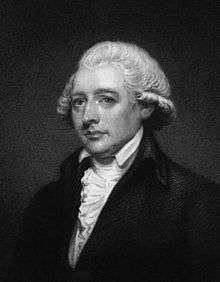
William Cumberland Cruikshank
William Cumberland Cruikshank (1745, Edinburgh – 27 June 1800) was a British chemist and anatomist. He was the author of The Anatomy of the Absorbing Vessels of the Human Body, which was first published in 1786.[1][2]
He went to London in 1771 and became assistant to William Hunter in his anatomical work.[1] In 1797, he was the first to demonstrate that a particular crystallizable substance exists in the urine and is precipitated from it by nitric acid.[3] He identified carbon monoxide as a compound containing carbon and oxygen in 1800.[4] In 1800 he also used chlorine to purify water.[5]
He was elected a Fellow of the Royal Society in June 1797.[6]
Notes and references
- 1 2 Pilcher, Lewis Stephen (1918). A List of Books by Some of the Old Masters of Medicine and Surgery, p. 132. Brooklyn, New York.
- ↑ Quain, Jones (1892). Quain's Elements of Anatomy, Vol. II, Part II, p. 546. London: Longmans, Green and Co.
- ↑ Coulson, William (1857). On the diseases of the bladder and prostate gland , p. 15. Churchill.
- ↑ Roscoe, Henry E. and Schorlemmer, Carl (1920). A Treatise on Chemistry (5th ed.), p. 797. London: Macmillan and Co., Limited.
- ↑ Rideal, Samuel (1895). Disinfection and Disinfectants, p. 59. J.B. Lippincott Co.
- ↑ "Library and Archive Catalogue". Royal Society. Retrieved 26 December 2010.
Further reading
- McDonald, Stuart W. (2015). "William Cruikshank (1745-1800), anatomist and surgeon, and his illustrious patient, Samuel Johnson". Clinical Anatomy. 28 (7): 836–843. doi:10.1002/ca.22567. ISSN 0897-3806.
- Rose, F Clifford (31 October 2011). History of British Neurology. World Scientific. pp. 75–77. ISBN 978-1-908977-84-7.
- "William C. Cruikshank (1745-1800) Surgeon of Leicester Square". JAMA: The Journal of the American Medical Association. 214 (6): 1110. 1970. doi:10.1001/jama.1970.03180060084019. ISSN 0098-7484.
 |
Wikimedia Commons has media related to William Cumberland Cruikshank. |
This article is issued from Wikipedia - version of the 7/17/2016. The text is available under the Creative Commons Attribution/Share Alike but additional terms may apply for the media files.