zSpace (company)
 | |
| Private | |
| Industry | Virtual and augmented reality |
| Founded | 2007[1][2] |
| Headquarters | Sunnyvale, California |
Key people | |
| Website |
zspace |
zSpace is a technology firm based in Sunnyvale, California that creates real world virtual reality systems. zSpace allows people to interact with simulated objects in virtual environments as if they are real.[3][4][5]
zSpace is known for its progressive developments in human-computer interaction.[6] Paul Kellenberger is the company's current CEO and President.[7]
History

The prototype for the zSpace holographic platform was created with backing from the Central Intelligence Agency's In-Q-Tel fund, which invests in technology startups.[8] The innovation represented a new approach to problem solving, designing, teaching, and communicating.
zSpace found its place among relatively untapped "geospatial markets" with users who would make use of 3-D manipulation technologies.[3] Although the initial target markets were enterprise and STEM education,[9] prospective clients began to recognize a nearly limitless potential for zSpace applications in any endeavor where 3-D study and interaction would be beneficial.[3][4][5] Gaming developers and consumers also began to take a keen interest in the budding company.[3][5] zSpace soon found its way into a variety of sectors including government, medicine and education.[3][4][5][10]
zSpace has garnered several positive reviews for its "mind-boggling" holographic display.[3][4] Conversely, some critics suggested that zSpace might be cost-prohibitive for the average consumer.[3][4] Company executives publicly stated in April 2013 that they "[expected] the price of the zSpace to fall below $1000 within 18 to 24 months."[5]
zSpace executives have turned their attention to developing partnerships with "active players" in the VR industry, and made their "primary focus" virtual reality for education and, [to get] applications on zSpace."[10] In November 2012, zSpace released an independent software development kit.[4]
zSpace was a featured product for NASA's "TechBriefs".[11] In 2012, zSpace was awarded "Best in Show" at the Computer Graphics World Conference.[11] The company also received the Core77 Design Award as "Professional Notable" in Consumer Products.[11] In 2013, zSpace was a finalist in the American Technology Awards in Advanced Manufacturing/Tech Manufacturing.
In 2014, zSpace collaborated with researchers at the University of Tokyo to develop a high speed gesture tracking system. The technology is being used in hospitals by surgeons before procedures.[12][13] The Los Altos School District began a pilot program using zSpace in STEM classrooms.[14][15] The technology is also used at UCSF and Stanford for research and medical education, and was featured by Intel at CES 2014.[16]
zSpace is collaborating with NASA to be tested as interface technology for future robots, using the program to interact with simulated objects in virtual environments using its imaging displays.[17]
Product
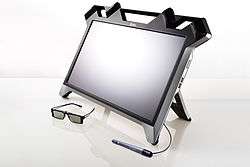
At CES 2015, HP announced the HP zVR powered by technology licensed from zSpace. The zSpace system allows for the visualization of data in three dimensions.[10] It consists of three user-responsive components: a stereoscopic display, stylus, and glasses.[5][7] Working together, these components create an "augmented reality" or "immersive realistic interaction" in which data that appears as a "real object" can be viewed, manipulated, analyzed, and shared.[3] The technology could also be used for virtual hands-on training and gaming.[18]
The zSpace system uses a 1920 x 1080 pixel LCD screen, and the hardware switches between the left and right images through a circularly polarized light that enters the eye.[19] The glasses contain small reflective tabs that the computer uses to track where users are looking.[20] This software prevents nausea and headaches by keeping the image focused.[21][22]
References
- ↑ Wilson, Jeremy (September 16, 2013). "You Won't Believe The Startups The CIA Has Invested In". The Kernel. Retrieved June 5, 2015.
- ↑ Hickey, Walter (August 11, 2012). "25 Cutting Edge Firms Funded By The CIA". Business Insider. Retrieved June 5, 2015.
- 1 2 3 4 5 6 7 8 Knight, Will. "A Display That Makes Interactive 3-D Seem Mind-Bogglingly Real". MIT Technology Review. Retrieved 1 July 2013.
- 1 2 3 4 5 6 Wilson, Mark. "zSpace: A Real Holographic Display Worthy Of Iron Man". Fast Company. Retrieved 1 July 2013.
- 1 2 3 4 5 6 Johnson, Eric. "heap Mobile Games? Bah! Meet zSpace's $4,000 3-D Monitor.". AllThingsD. Retrieved 1 July 2013.
- ↑ "zSpace, Inc. Partnership With Siemens PLM Software Delivers Enhanced 3D Visualization Solution". Sys-Con Media. Retrieved 1 July 2013.
- 1 2 "Infinite Z's zSpace". upFront.eZine. Retrieved 1 July 2013.
- ↑ Henn, Steve. "In-Q-Tel: The CIA's Tax-Funded Player In Silicon Valley". NPR. Retrieved 1 July 2013.
- ↑ "High Speed Gesture UI for Three Dimensional Display zSpace". Ishikawa Watanabe Laboratory. Retrieved 17 August 2014.
- 1 2 3 "zSpace, Inc. Partnership With Siemens PLM Software Delivers Enhanced 3D Visualization Solution". MarketWatch. Retrieved 1 July 2013.
- 1 2 3 "Core77 Design Awards 2012: zSpace, Professional Notable for Consumer Products". Core77. Retrieved 1 July 2013.
- ↑ "Real-Time Touch-Free Gesture Control System for Image Browsing in The OR". medGadget. 27 May 2014. Retrieved 17 August 2014.
- ↑ Alyssa. "BBC and Dassault Systemes ask: how can technology shape the future?". Dassault Systemes. Retrieved 17 August 2014.
- ↑ Aguirre, Jessica (2 May 2014). "Los Altos School District Tries Out Virtual Reality in the Classroom". NBC. Retrieved 17 August 2014.
- ↑ Jessica Aguirre; Barb Kunz (2 May 2014). "Los Altos School District Tries Out Virtual Reality in the Classroom". NBC Bay Area. Retrieved 28 August 2014.
- ↑ "Intel's pre-CES 2014 keynote". The Verge. Retrieved 28 August 2014.
- ↑ Venables, Michael (25 February 2014). "NASA's "New Apollo Moment": Naturally Guiding Robotic Avatars In Space Exploration". Medium. Retrieved 17 August 2014.
- ↑ "Is zSpce Device Revolutionary, Or Just Doing it Right for Once". Inquisitr. 26 May 2014. Retrieved 29 July 2014.
- ↑ "1400社がアプリ開発 米社のVR装置、教育・医療へ". Nikkei. 7 May 2014. Retrieved 17 August 2014.
- ↑ Geron, Tomio (24 September 2014). "zSpace Makes Immersive 3D Computing a Reality". Forbes. Retrieved 17 August 2014.
- ↑ Emspak, Jesse (9 September 2013). "3-D Display Tracks Head for Vomit Free Views". Discovery.com. Retrieved 17 August 2014.
- ↑ Pierce, Dennis (12 February 2014). "zSpace takes 3D learning to a whole new level". eSchool News. Retrieved 17 August 2014.