Zori–Stalker–Williams syndrome
| Zori–Stalker–Williams syndrome | |
|---|---|
| Classification and external resources | |
| OMIM | 600399 |
Zori–Stalker–Williams syndrome, also known as pectus excavatum, macrocephaly, short stature and dysplastic nails,[1] is a rare autosomal dominant[2] congenital disorder associated with a range of features such as pectus excavatum, macrocephaly and dysplastic nails, familial short stature, developmental delay and distinctive facies.[3][4] Further signs are known to be associated with this syndrome.[5]
The name originates from the researchers who first defined and noticed the syndrome and its clinical signs.[1]
It is believed that the syndrome is inherited in an autosomal dominant pattern, though there has been no new research undertaken for this rare disease.[1]
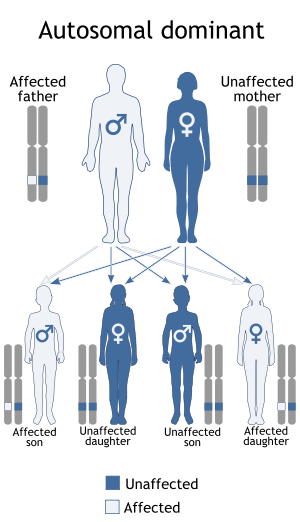
Zori–Stalker–Williams syndrome has an autosomal dominant pattern of inheritance.
References
- 1 2 3 Online Mendelian Inheritance in Man (OMIM) Pectus Excavatum, Macrocephaly, Short Stature, Dysplastic Nails -600399 - Pectus Excavatum, Macrocephaly, Short Stature, Dysplastic Nails
- ↑ Zori RT, Stalker HJ, Williams CA (1992). "A syndrome of familial short stature, developmental delay, pectus abnormalities, distinctive facies, and dysplastic nails". Dysmorph Clin Genet.It is listed as a "rare disease" by the Office of Rare Diseases (ORD) of the National Institutes of Health (NIH). This means that Zori Stalker Williams syndrome, or a subtype of Zori Stalker Williams syndrome, affects less than 200,000 people in the US population or one person per 2000 people. 6: 116–122.
- ↑ Zori Stalker Williams syndrome at NIH's Office of Rare Diseases
- ↑ "Pectus excavatum macrocephaly dysplastic nails". Orphanet.
- ↑ ORPHANET - About rare diseases - About orphan drugs
This article is issued from Wikipedia - version of the 7/21/2016. The text is available under the Creative Commons Attribution/Share Alike but additional terms may apply for the media files.