1-Methylnaphthalene
 | |
 | |
| Names | |
|---|---|
| IUPAC name
1-Methylnaphthalene | |
| Other names
α-methylnaphthalene | |
| Identifiers | |
90-12-0  | |
| 3D model (Jmol) | Interactive image |
| ChEBI | CHEBI:50717 |
| ChEMBL | ChEMBL383808 |
| ChemSpider | 6736 |
| ECHA InfoCard | 100.001.788 |
| EC Number | 201-966-8 |
| KEGG | C14082 |
| PubChem | 7002 |
| |
| |
| Properties | |
| C11H10 | |
| Molar mass | 142.20 g/mol |
| Appearance | Liquid |
| Density | 1.001 g/mL |
| Melting point | −22 °C (−8 °F; 251 K) |
| Boiling point | 240–243 °C (464–469 °F; 513–516 K) |
| Vapor pressure | 4.91 |
| Hazards | |
| R-phrases | R22 R42 R43 |
| S-phrases | S7 S36 S37 S39 |
| Flash point | 82 °C (180 °F; 355 K) |
| Except where otherwise noted, data are given for materials in their standard state (at 25 °C [77 °F], 100 kPa). | |
verify (what is  ?) ?) | |
| Infobox references | |
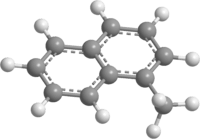
1-Methylnaphthalene is a polycyclic aromatic hydrocarbon (PAH). It has a cetane number of zero, and was previously used as the lower reference for cetane number. However, due to the expense and handling difficulty of 1-methylnaphthalene, it was replaced in this capacity by isocetane, with a CN of 15.[2]
On February 22, 2014, NASA announced a greatly upgraded database[3][4] for detecting and monitoring PAHs, including 1-methylnaphthalene, in the universe. According to NASA scientists, over 20% of the carbon in the universe may be associated with PAHs, possible starting materials for the formation of life.[3] PAHs seem to have been formed shortly after the Big Bang, are abundant in the universe,[5][6][7] and are associated with new stars and exoplanets.[3]
See also
References
- ↑ 1-Methylnaphthalene at University of Oxford
- ↑ Cetane number
- 1 2 3 Hoover, Rachel (February 21, 2014). "Need to Track Organic Nano-Particles Across the Universe? NASA's Got an App for That". NASA. Retrieved February 22, 2014.
- ↑ Staff (October 29, 2013). "PAH IR Spectral Database". NASA. Retrieved March 12, 2014.
- ↑ Carey, Bjorn (October 18, 2005). "Life's Building Blocks 'Abundant in Space'". Space.com. Retrieved March 3, 2014.
- ↑ Hudgins, Douglas M.; Bauschlicher Jr, Charles W.; Allamandola, L. J. (October 10, 2005). "Variations in the Peak Position of the 6.2 μm Interstellar Emission Feature: A Tracer of N in the Interstellar Polycyclic Aromatic Hydrocarbon Population". Astrophysical Journal. 632: 316–332. doi:10.1086/432495. Retrieved March 3, 2014.
- ↑ Allamandola, Louis; et al. (April 13, 2011). "Cosmic Distribution of Chemical Complexity". NASA. Retrieved March 3, 2014.