A-sharp minor
 | |
| Relative key |
C♯ major enharmonic: D♭ major |
|---|---|
| Parallel key |
A♯ major enharmonic: B♭ major |
| Dominant key |
E♯ minor enharmonic: F minor |
| Subdominant |
D♯ minor enharmonic: E♭ minor |
| Enharmonic | B♭ minor |
| Component pitches | |
| A♯, B♯, C♯, D♯, E♯, F♯, G♯, A♯ | |



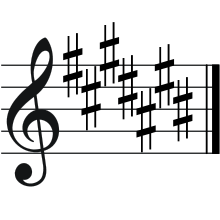
A-sharp minor or A♯ minor is a minor scale based on A-sharp. The A♯ minor scale has pitches A♯, B♯, C♯, D♯, E♯, F♯, and G♯. For the harmonic minor scale, G is used instead of G♯. Its key signature has seven sharps (see below: Scales and keys).
Its relative major is C♯ major (or enharmonically D♭ major), and its parallel major is A♯ major, usually replaced by B♭ major, since A♯ major's three double-sharps make it impractical to use. Exceptions include Chopin's Polonaise-Fantaisie in A-flat major, Op. 61, which has a brief passage of about 6 bars actually notated in A-sharp major, inserting the necessary double-sharps as accidentals. The overall harmonic context is an extended theme in B major, which briefly modulates to A-sharp major.
A♯ minor's direct enharmonic equivalent is B♭ minor.
Changes needed for the melodic and harmonic versions of the scale are written in with accidentals as necessary.
A-sharp minor is one of the least used minor keys in music as it is not a practical key for composition. The enharmonic equivalent B-flat minor, which would only contain five flats as opposed to A-sharp minor's seven sharps, is normally used. There is, however, in Bach's Prelude and Fugue in C♯ major, a brief section near the beginning of the piece which modulates to A♯ minor.
External links
Scales and keys
| Diatonic scales and keys | |||||||||||||||||||||||||||||||||||||||||||||||||||||||
|---|---|---|---|---|---|---|---|---|---|---|---|---|---|---|---|---|---|---|---|---|---|---|---|---|---|---|---|---|---|---|---|---|---|---|---|---|---|---|---|---|---|---|---|---|---|---|---|---|---|---|---|---|---|---|---|
 |
| ||||||||||||||||||||||||||||||||||||||||||||||||||||||
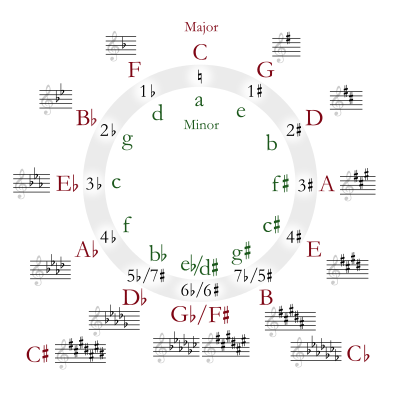
| The table indicates the number of sharps or flats in each scale. Minor scales are written in lower case. | |||||||||||||||||||||||||||||||||||||||||||||||||||||||