G-sharp minor
 | |
| Relative key | B major |
|---|---|
| Parallel key |
G♯ major enharmonic: A♭ major |
| Dominant key |
D♯ minor enharmonic: E♭ minor |
| Subdominant | C♯ minor |
| Component pitches | |
| G♯, A♯, B, C♯, D♯, E, F♯, G♯ | |
 G-sharp natural minor scale ascending and descending.  Play Play  G-sharp harmonic minor scale ascending and descending. Play  G-sharp melodic minor scale ascending and descending. Play |
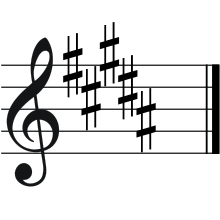
G-sharp minor is a minor scale based on G♯, consisting of the pitches G♯, A♯, B, C♯, D♯, E, and F♯. For the harmonic minor, the F♯ is raised to F . Its key signature has five sharps.
Its relative major is B major. Its parallel major, G♯ major, is usually replaced by its enharmonic equivalent of A♭ major, since G♯ major features an F in the key signature and A♭ major only has four flats, making it rare for G♯ major to be used. A♭ minor, with seven flats, has a similar problem, thus G♯ minor is often used as the parallel minor for A♭ major.
Despite the key rarely being used in orchestral music other than to modulate, it is not entirely uncommon in keyboard music, as in Piano Sonata No. 2 by Alexander Scriabin. It can also found in the second movement in Shostakovitch's 8th String quartet. If G-sharp minor is used, composers generally write B-flat wind instruments in the enharmonic B-flat minor, rather than A-sharp minor to facilitate reading the music.
In a few scores, the sharp A in the bass clef is written on the top line.
Well-known compositions in this key
Few symphonies are written in G ♯ minor; among them are Nikolai Myaskovsky's 17th Symphony, Christopher Schlegel's 5th Symphony and an abandoned work of juvenilia by Marc Blitzstein.
Johann Sebastian Bach's The Well-Tempered Clavier No. 18: Prelude and Fugue in G-sharp minor, Books 1 (1722) and 2 (1744),[1] are among the works in this key.
Chopin composed a Polonaise in G-Sharp Minor, opus posthumous in 1822. His Étude No. 6 is in G-sharp minor as well.
Lizst's La campanella from his Grandes études de Paganini is in G-Sharp minor.
References
Notes
- ↑ Albert Schweitzer, (1935). J. S. Bach. Volume 1. New York: Macmillan Publishers.
Sources
- A. Morris, "Symphonies, Numbers and Keys" in Bob's Poetry Magazine, III.3, 2006.
Scales and Keys
| Diatonic scales and keys | |||||||||||||||||||||||||||||||||||||||||||||||||||||||
|---|---|---|---|---|---|---|---|---|---|---|---|---|---|---|---|---|---|---|---|---|---|---|---|---|---|---|---|---|---|---|---|---|---|---|---|---|---|---|---|---|---|---|---|---|---|---|---|---|---|---|---|---|---|---|---|
 |
| ||||||||||||||||||||||||||||||||||||||||||||||||||||||
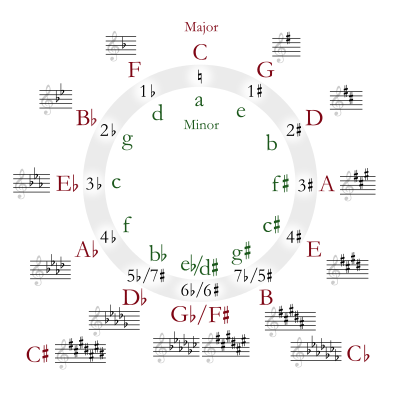
| The table indicates the number of sharps or flats in each scale. Minor scales are written in lower case. | |||||||||||||||||||||||||||||||||||||||||||||||||||||||
External links
- G-sharp minor