Antioch, Nebraska
| Antioch, Nebraska | |
|---|---|
| Ghost town | |
|
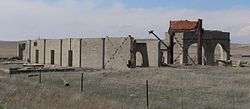
Ruins of potash plant near Antioch | |
  Antioch, Nebraska Location within the state of Nebraska | |
| Coordinates: 42°04′06″N 102°34′56″W / 42.06833°N 102.58222°WCoordinates: 42°04′06″N 102°34′56″W / 42.06833°N 102.58222°W[1] | |
| Country | United States |
| State | Nebraska |
| County | Sheridan |
| Elevation[1] | 3,881 ft (1,183 m) |
| Time zone | [MST] (UTC-6) |
| • Summer (DST) | MST (UTC) |
| Area code(s) | 308 |
| GNIS feature ID | 834979 |
Antioch is a ghost town in Sheridan County, Nebraska, United States. Located approximately 15 miles east of Alliance on Nebraska Highway 2, the town was once nicknamed "the potash capital of Nebraska."[2] The town took its name from Antioch, Ohio.[3]
The location of the town near several major alkali lakes among the Sandhills of western Nebraska made Antioch the logical home of five potash reduction factories: the American, Nebraska, Alliance, National, and Western potash companies.[4] All these companies were major suppliers of potash during World War I.
As a late boomtown, Antioch sprang out of the war-driven needs. According to one historian, the year before the United States became involved in World War I, the town only had one schoolhouse, a church, and a store. With the advent of a method to distill potash from western Nebraska's alkali lakes by University of Nebraska scientists, by 1917 Antioch was "a small city."[5] Antioch quickly had five large-scale potash plants, and within months the town had more than 5,000 residents. Following the war the population left again.[6]
When Germany resumed trade with the United States in 1921, the potash trade was decimated. The factories immediately closed.[2] The machinery was sold for scrap; the factories were demolished for the salvage value of the building materials; and the company housing was torn down or moved. Only the foundations of the factories and of some of the larger houses remained.[7] Today, Antioch has fewer than 25 residents.
In 1979, the remains of Antioch's potash plants were added to the National Register of Historic Places.[8]
References
- 1 2 Geographic Names Information System Feature Detail Report. Geographic Names Information System. 2000-01-01. Retrieved 2010-10-03.
- 1 2 Hickey, Donald R.; Wunder, Susan A.; Wunder, John R. (2007). Nebraska Moments. U of Nebraska Press. p. 165. ISBN 0-8032-1572-X.
- ↑ Federal Writers' Project (1938). Origin of Nebraska place names. Lincoln, NE: Works Progress Administration. p. 5.
- ↑ "The Great WWI Potash Industry of Southern Sheridan County, Nebraska" Sheridan County Historical Society. p. 2. Retrieved Sept. 25, 2010.
- ↑ (1919) The American Missionary. Volume 73. Congregational Home Missionary Society, American Missionary Association.
- ↑ "Antioch: Potash boom town". Nebraska State Historical Society. Retrieved Sept. 25, 2010.
- ↑ Jensen, Richard E. "National Register of Historic Places Inventory--Nomination Form: Antioch Potash Plants". Nebraska State Historical Society. Retrieved 2013-10-18.
- ↑ "Nebraska National Register Sites in Sheridan County". Nebraska State Historical Society. Retrieved 2013-10-18.
External links
- "The Great WWI Potash Industry of Southern Sheridan County, Nebraska" Sheridan County Historical Society.
- "Antioch, Nebraska" on Ghosttowns.com
- Antioch Graveyard photo from NebraskaGravestonres.org
Municipalities and communities of Sheridan County, Nebraska, United States | ||
|---|---|---|
| Cities | 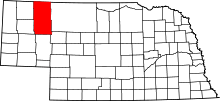 | |
| Villages | ||
| CDP | ||
| Unincorporated communities | ||
| Ghost town | ||
| Indian reservation | ||
| Footnotes | ‡This populated place also has portions in an adjacent county or counties | |