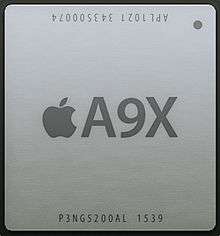
Apple A9X
The Apple A9X is a 64-bit ARM based system on a chip (SoC) designed by Apple Inc. It first appeared in the iPad Pro, which was announced on September 9, 2015 and was released on November 11, 2015.[6] The A9X has the M9 motion coprocessor embedded in it, which had not been before. It is a variant of the A9 and Apple claims that it has 1.8 times the CPU performance and 2 times the GPU performance of its predecessor, the A8X.[7]
Design
The A9X features an Apple-designed 64-bit ARMv8-A dual-core CPU called "Twister".[5] It offers double the memory bandwidth and double the storage performance of the Apple A8X.[8]
Unlike the A9, the A9X does not contain a L3 cache due to its significant DRAM bandwidth. The A9X is paired with 4 GB of LPDDR4 memory in the 12.9" iPad Pro and 2 GB of LPDDR4 memory in the 9.7" iPad Pro with a total bandwidth of 51.2 GB/s. This high bandwidth is necessary to feed the SoC's dodeca-core PowerVR 7 Series GPU cores.[9] The RAM is not included in the A9X package unlike its sibling, the A9.
The A9X uses the same NAND interface as the A9, which uses an Apple-designed NVMe-based controller that communicates over a PCIe connection.[10] The iPad Pro's NAND design is more akin to a PC-class SSD than embedded flash memory common on mobile devices. This gives the iPad Pro a significant storage performance advantage over competitors which often use mSATA or eMMC to connect to their storage systems.
Products that include the Apple A9X
See also
References
- ↑ 9.7 inch iPad Pro includes 2 GB RAM, slightly slower CPU than 12.9 inch iPad Pro
- 1 2 "The A9X SoC & More To Come - The iPad Pro Preview: Taking Notes With iPad Pro". AnandTech. November 11, 2015. Retrieved November 11, 2015.
- 1 2 Smith, Ryan (November 30, 2015). "More on Apple's A9X SoC". AnandTech. Retrieved November 30, 2015.
- ↑ Joshua Ho. "iPhone 6s and iPhone 6s Plus Preliminary Results". anandtech.com.
- 1 2 Joshua Ho, Ryan Smith. "A9's CPU: Twister - The Apple iPhone 6s and iPhone 6s Plus Review". anandtech.com.
- ↑ "Apple Introduces iPad Pro Featuring Epic 12.9-inch Retina Display" (Press release). Apple. September 9, 2015. Retrieved September 9, 2015.
- ↑ Chester, Brandon (September 9, 2015). "Apple Announces the iPad Pro and iPad Mini 4". AnandTech. Retrieved September 9, 2015.
- ↑ "Apple's new iPad Pro is an expansive 12.9 inches, available in November". Ars Technica. Retrieved 9 September 2015.
- ↑ "More on Apple's A9X SoC: 147mm2@TSMC, 12 GPU Cores, No L3 Cache". AnandTech. Retrieved 30 November 2015.
- ↑ "The Apple iPad Pro Review". Retrieved 25 January 2016.
Application ARM-based chips |
|---|
|
|
|
Application
processors
(32-bit) | | |
|---|
| | |
|---|
| | |
|---|
| |
- Actions ATM702x, ATM703x
- Altera Cyclone V, Arria V/10
- Amlogic AML8726, MX, M6x, M801, M802/S802, S812, T866
- Apple A5, A5X
- Broadcom VideoCore BCM21xxx, BCM28xxx
- Freescale i.MX6
- HiSilicon K3V2
- InfoTM iMAPx912
- Leadcore LC1810, LC1811
- MediaTek MT65xx
- Nvidia Tegra, 2, 3, 4i
- Nufront NuSmart 2816M, NS115, NS115M
- Renesas EMMA EV2, R-Car H1, RZ/A
- Rockchip RK292x, RK30xx, RK31xx
- Samsung Exynos 4
- ST-Ericsson NovaThor
- Telechips TCC8803
- Texas Instruments OMAP 4
- VIA WonderMedia WM88x0, 89x0
- Xilinx Zynq-7000
- ZiiLABS ZMS-20, ZMS-40
|
|---|
| | |
|---|
| | |
|---|
| ARMv7-A
compatible | |
|---|
|
|---|
|
Application
processors
(64-bit) | |
|---|
iOS and iOS-based products |
|---|
|
|
|
| Hardware | | |
|---|
|
| Software | |
|---|
|
| Bundled apps | |
|---|
|
| Apple apps | |
|---|
|
| Services | |
|---|
|
| Other | |
|---|
|
|---|
|
|
|
| Founders | | |
|---|
|
Board of
directors | |
|---|
|
| Executives | |
|---|
|
| Services | |
|---|
|
| Products | |
|---|
|
| Companies | |
|---|
|
| Related | |
|---|
|
|