Artin–Tate lemma
In algebra, the Artin–Tate lemma, named after Emil Artin and John Tate, states:[1]
- Let A be a Noetherian ring and algebras over A. If C is of finite type over A and if C is finite over B, then B is of finite type over A.

(Here, "of finite type" means "finitely generated algebra" and "finite" means "finitely generated module".) The lemma was introduced by E. Artin and J. Tate in 1951[2] to give a proof of Hilbert's Nullstellensatz.
Proof
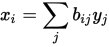
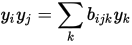
The following proof can be found in Atiyah–MacDonald.[3] Let generate as an -algebra and let generate as a -module. Then we can write and with . Then is finite over the -algebra generated by the . Using that and hence is Noetherian, also is finite over . Since is a finitely generated -algebra, also is a finitely generated -algebra.




Noetherian necessary
Without the assumption that A is Noetherian, the statement of the Artin-Tate lemma is no longer true. Indeed, for any non-Noetherian ring A we can define an A-algebra structure on by declaring . Then for any ideal which is not finitely generated, is not of finite type over A, but all conditions as in the lemma are satisfied.




References
- ↑ Eisenbud, Exercise 4.32
- ↑ E Artin, J.T Tate, "A note on finite ring extensions," J. Math. Soc Japan, Volume 3, 1951, pp. 74–77
- ↑ Atiyah–MacDonald 1969, Proposition 7.9
- Eisenbud, David, Commutative Algebra with a View Toward Algebraic Geometry, Graduate Texts in Mathematics, 150, Springer-Verlag, 1995, ISBN 0-387-94268-8.
- M. Atiyah, I.G. Macdonald, Introduction to Commutative Algebra, Addison–Wesley, 1994. ISBN 0-201-40751-5