Augmented major seventh chord
| Component intervals from root | |
|---|---|
| major seventh | |
| augmented fifth | |
| major third | |
| root | |
| Forte no. / | |
|
4-19 / |
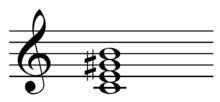
 play .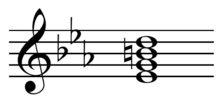

In music, an augmented major seventh chord, or major seventh sharp five chord, or simply augmented seventh chord[2] (written as aug7, augM7, +7, +M7, +Δ7, M7♯5, M7(♯5), M7/♯5, M7+5, etc.) is a nondominant seventh chord comprising the root note, the note a major third above the root, the note an augmented fifth above the root, and the note a major seventh above the root: 1-3-♯5-7, and is associated with the augmented scale[3] (see jazz scale and chord-scale system). When used in jazz scores, a number of symbols can be used to represent this chord, including maj+7, and Δ+7.
This chord comes from the third mode of both the harmonic minor and the melodic minor scales. For example, the third mode of the A minor melodic consists of C, D, E, F♯, G♯, A, and B. Therefore, the notes of the C maj7(♯5) chord are C, E, G♯, and B.
As with dominant seventh chords, nondominant seventh chords including the augmented major seventh usually progress according to the circle, thus III+ resolves to vi or VI.[4] For example, C maj7(♯5) usually resolves to F.
The chord can be represented by the integer notation {0, 4, 8, 11}.
Augmented major seventh chord table
| Chord | Root | Major third | Augmented fifth | Major seventh |
|---|---|---|---|---|
| Cmaj7(♯5) | C | E | G♯ | B |
| C♯maj7(♯5) | C♯ | E♯ (F) | G (A) (A) |
B♯ (C) |
| D♭maj7(♯5) | D♭ | F | A | C |
| Dmaj7(♯5) | D | F♯ | A♯ | C♯ |
| D♯maj7(♯5) | D♯ | F (G) |
A (B) |
C (D) |
| E♭maj7(♯5) | E♭ | G | B | D |
| Emaj7(♯5) | E | G♯ | B♯ (C) | D♯ |
| Fmaj7(♯5) | F | A | C♯ | E |
| F♯maj7(♯5) | F♯ | A♯ | C (D) |
E♯ (F) |
| G♭maj7(♯5) | G♭ | B♭ | D | F |
| Gmaj7(♯5) | G | B | D♯ | F♯ |
| G♯maj7(♯5) | G♯ | B♯ (C) | D (E) |
F (G) |
| A♭maj7(♯5) | A♭ | C | E | G |
| Amaj7(♯5) | A | C♯ | E♯ (F) | G♯ |
| A♯maj7(♯5) | A♯ | C (D) |
E (F♯) |
G (A) |
| B♭maj7(♯5) | B♭ | D | F♯ | A |
| Bmaj7(♯5) | B | D♯ | F (G) |
A♯ |