Magic chord
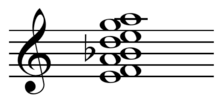
 Play
Play The Magic Chord is a chord and installation (1984) created by La Monte Young, consisting of the pitches E, F, A, B♭, D, E, G, and A, in ascending order and used in works including his The Well-Tuned Piano and Chronos Kristalla (1990).[1] The latter was performed by the Kronos Quartet and features all notes of the magic chord as harmonics on open strings.[1] The quartet has been described as, "offer[ing] perhaps the ultimate challenge in performing in a just environment."[2]
Described as, "complex and throbbing," the chord does not contain its fundamental (see root (chord)),[3] E♭, and is a subset of the Romantic Chord,[4] G-Dorian in eight octaves, spelled G,A,B,C,D,E,F♯,G.[5] "When the Magic Opening Chord is obtained by playing the Opening Chord at one end of a room while the Magic Chord is played at the other (as Young set it up for me), the feeling-changes of the stereo effect as you move back and forth[-]are dazzling."[3] The opening chord consists of E♭, B♭, C, E♭, F, B♭ (ratios 4:6:7:8:9:12 Play ),[6] adding C[7] and E♭ to the magic chord when combined as the magic opening chord ( Play ).
The Well-Tuned Piano is based on a pitch lattice of perfect fifths and harmonic sevenths, and the tuning of the magic chord is as follows:[8]
| Note | Note | (E♭) | E | F | G | A | B♭ | (C) | D | ||||||||
|---|---|---|---|---|---|---|---|---|---|---|---|---|---|---|---|---|---|
| Ben Johnston notation | (E♭) | F7++ | F+ | A7b+ | B7b+ | Bb | (D7b) | E7b+ | |||||||||
| Ratio | (1/1) | 567/512 | 9/8 | 21/16 | 189/128 | 3/2 | (7/4) | 63/32 | |||||||||
| Audio (from C) |
(E♭ ) | E | F | G | A | B♭ | (C ) | D | |||||||||
| Step | Ratio | 567/512 | 64/63 | 7/6 | 9/8 | 64/63 | 32/27 | 9/8 | |||||||||
For example, G (21/16) is the harmonic seventh of the perfect fifth (7/4 * 3/2 = 21/16):
| P5 | |||||
|---|---|---|---|---|---|
| H7 | 49 | 147 | 441 | 1323 | (3969) |
| B | F♯ | C♯ | G♯ | ||
| 7 | 21 | 63 | 189 | 567 | |
| C | G | D | A | E | |
| 1 | 3 | 9 | (27) | (81) | |
| E♭ | B♭ | F | |||
Sources
- 1 2 3 Grimshaw, Jeremy (2011). Draw A Straight Line and Follow It: The Music and Mysticism of La Monte Young, p.176. ISBN 978-0-19-974020-8.
- ↑ Strange, Patricia and Strange, Allen (2001). The Contemporary Violin: Extended Performance Techniques, p.160. ISBN 978-0-520-22409-4.
- 1 2 Duckworth, William (2009). Sound and Light: La Monte Young and Marian Zazeela, p.187. ISBN 978-0-8387-5738-3.
- ↑ Potter, Keith (2002). Four Musical Minimalists: La Monte Young, Terry Riley, Steve Reich, Philip Glass, p.86. Cambridge. ISBN 9780521015011.
- ↑ Duckworth (2009), p.85-6.
- ↑ Duckworth (2009), p.168.
- ↑ Potter (2002), p.87.
- ↑ Gann, Kyle (1997). "La Monte Young's The Well-Tuned Piano", La Monte Young Web Page.