Beta adrenergic receptor kinase-2
| GRK3 | |||||||||||||||||
|---|---|---|---|---|---|---|---|---|---|---|---|---|---|---|---|---|---|
| Identifiers | |||||||||||||||||
| Aliases | GRK3, BARK2, ADRBK2, Beta adrenergic receptor kinase-2, G protein-coupled receptor kinase 3 | ||||||||||||||||
| External IDs | MGI: 87941 HomoloGene: 21072 GeneCards: GRK3 | ||||||||||||||||
| Targeted by Drug | |||||||||||||||||
| balanol[1] | |||||||||||||||||
| |||||||||||||||||
| RNA expression pattern | |||||||||||||||||
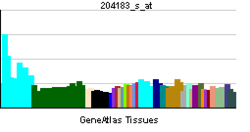 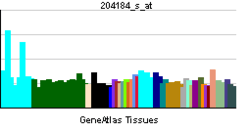 | |||||||||||||||||
| More reference expression data | |||||||||||||||||
| Orthologs | |||||||||||||||||
| Species | Human | Mouse | |||||||||||||||
| Entrez | |||||||||||||||||
| Ensembl | |||||||||||||||||
| UniProt | |||||||||||||||||
| RefSeq (mRNA) | |||||||||||||||||
| RefSeq (protein) | |||||||||||||||||
| Location (UCSC) | Chr 22: 25.56 – 25.73 Mb | Chr 5: 112.91 – 113.02 Mb | |||||||||||||||
| PubMed search | [2] | [3] | |||||||||||||||
| Wikidata | |||||||||||||||||
| View/Edit Human | View/Edit Mouse |
Beta-adrenergic receptor kinase 2 (beta-ARK-2) also known as G-protein-coupled receptor kinase 3 (GRK3) is an enzyme that in humans is encoded by the ADRBK2 gene.[4][5]
Function
The beta-adrenergic receptor kinase specifically phosphorylates the agonist-occupied form of the beta-adrenergic and related G protein-coupled receptors. Overall, the beta adrenergic receptor kinase 2 has 85% amino acid similarity with beta adrenergic receptor kinase 1, with the protein kinase catalytic domain having 95% similarity. These data suggest the existence of a family of receptor kinases which may serve broadly to regulate receptor function.[5]
Discovery
The beta adrenergic receptor kinase-2 was cloned from mice and rats in 1991[6] and the human gene was cloned in 1993.[7]
Clinical significance
gene linkage techniques were used to identify a mutation in the GRK3 gene as a possible cause of up to 10% of cases of bipolar disorder.[8] Beta adrenergic receptor kinase-2 appears to affect dopamine metabolism. Subsequent studies, while noting that chromosome 22q12 may harbor a risk gene for schizophrenia, did not find that the gene coding for beta adrenergic receptor kinase-2 was linked to schizophrenia.[9]
It has been associated with WHIM syndrome.[10]
References
- ↑ "Drugs that physically interact with Beta-adrenergic receptor kinase 2 view/edit references on wikidata".
- ↑ "Human PubMed Reference:".
- ↑ "Mouse PubMed Reference:".
- ↑ Calabrese G, Sallese M, Stornaiuolo A, Stuppia L, Palka G, De Blasi A (Feb 1995). "Chromosome mapping of the human arrestin (SAG), beta-arrestin 2 (ARRB2), and beta-adrenergic receptor kinase 2 (ADRBK2) genes". Genomics. 23 (1): 286–8. doi:10.1006/geno.1994.1497. PMID 7695743.
- 1 2 "Entrez Gene: ADRBK2 adrenergic, beta, receptor kinase 2".
- ↑ Benovic JL, Onorato JJ, Arriza JL, Stone WC, Lohse M, Jenkins NA, Gilbert DJ, Copeland NG, Caron MG, Lefkowitz RJ (August 1991). "Cloning, expression, and chromosomal localization of beta-adrenergic receptor kinase 2. A new member of the receptor kinase family". J. Biol. Chem. 266 (23): 14939–46. PMID 1869533.
- ↑ Parruti G, Ambrosini G, Sallese M, De Blasi A (January 1993). "Molecular cloning, functional expression and mRNA analysis of human beta-adrenergic receptor kinase 2". Biochem. Biophys. Res. Commun. 190 (2): 475–81. doi:10.1006/bbrc.1993.1072. PMID 8427589.
- ↑ Barrett TB, Hauger RL, Kennedy JL, Sadovnick AD, Remick RA, Keck PE, McElroy SL, Alexander M, Shaw SH, Kelsoe JR (May 2003). "Evidence that a single nucleotide polymorphism in the promoter of the G protein receptor kinase 3 gene is associated with bipolar disorder". Mol. Psychiatry. 8 (5): 546–57. doi:10.1038/sj.mp.4001268. PMID 12808434.
- ↑ Yu SY, Takahashi S, Arinami T, Ohkubo T, Nemoto Y, Tanabe E, Fukura Y, Matsuura M, Han YH, Zhou RL, Shen YC, Matsushima E, Kojima T (February 2004). "Mutation screening and association study of the beta-adrenergic receptor kinase 2 gene in schizophrenia families". Psychiatry Res. 125 (2): 95–104. doi:10.1016/j.psychres.2003.12.003. PMID 15006433.
- ↑ Balabanian K, Levoye A, Klemm L, et al. (March 2008). "Leukocyte analysis from WHIM syndrome patients reveals a pivotal role for GRK3 in CXCR4 signaling". J. Clin. Invest. 118 (3): 1074–84. doi:10.1172/JCI33187. PMC 2242619
 . PMID 18274673.
Further reading
- Benovic JL, Onorato JJ, Arriza JL, et al. (1991). "Cloning, expression, and chromosomal localization of beta-adrenergic receptor kinase 2. A new member of the receptor kinase family". J. Biol. Chem. 266 (23): 14939–46. PMID 1869533.
- Parruti G, Ambrosini G, Sallese M, De Blasi A (1993). "Molecular cloning, functional expression and mRNA analysis of human beta-adrenergic receptor kinase 2". Biochem. Biophys. Res. Commun. 190 (2): 475–81. doi:10.1006/bbrc.1993.1072. PMID 8427589.
- Oppermann M, Freedman NJ, Alexander RW, Lefkowitz RJ (1996). "Phosphorylation of the type 1A angiotensin II receptor by G protein-coupled receptor kinases and protein kinase C". J. Biol. Chem. 271 (22): 13266–72. doi:10.1074/jbc.271.22.13266. PMID 8662816.
- Premont RT, Claing A, Vitale N, et al. (1998). "β2-Adrenergic receptor regulation by GIT1, a G protein-coupled receptor kinase-associated ADP ribosylation factor GTPase-activating protein". Proc. Natl. Acad. Sci. U.S.A. 95 (24): 14082–7. doi:10.1073/pnas.95.24.14082. PMC 24330. PMID 9826657.
- Oppermann M, Mack M, Proudfoot AE, Olbrich H (1999). "Differential effects of CC chemokines on CC chemokine receptor 5 (CCR5) phosphorylation and identification of phosphorylation sites on the CCR5 carboxyl terminus". J. Biol. Chem. 274 (13): 8875–85. doi:10.1074/jbc.274.13.8875. PMID 10085131.
- Dunham I, Shimizu N, Roe BA, et al. (1999). "The DNA sequence of human chromosome 22". Nature. 402 (6761): 489–95. doi:10.1038/990031. PMID 10591208.
- Inngjerdingen M, Damaj B, Maghazachi AA (2000). "Human NK cells express CC chemokine receptors 4 and 8 and respond to thymus and activation-regulated chemokine, macrophage-derived chemokine, and I-309". J. Immunol. 164 (8): 4048–54. doi:10.4049/jimmunol.164.8.4048. PMID 10754297.
- Celver JP, Lowe J, Kovoor A, et al. (2001). "Threonine 180 is required for G-protein-coupled receptor kinase 3- and beta-arrestin 2-mediated desensitization of the mu-opioid receptor in Xenopus oocytes". J. Biol. Chem. 276 (7): 4894–900. doi:10.1074/jbc.M007437200. PMID 11060299.
- Blaukat A, Pizard A, Breit A, et al. (2001). "Determination of bradykinin B2 receptor in vivo phosphorylation sites and their role in receptor function". J. Biol. Chem. 276 (44): 40431–40. doi:10.1074/jbc.M107024200. PMID 11517230.
- Wang J, Guan E, Roderiquez G, et al. (2002). "Role of tyrosine phosphorylation in ligand-independent sequestration of CXCR4 in human primary monocytes-macrophages". J. Biol. Chem. 276 (52): 49236–43. doi:10.1074/jbc.M108523200. PMID 11668182.
- Obara K, Arai K, Tomita Y, et al. (2002). "G-protein coupled receptor kinase 2 and 3 expression in human detrusor cultured smooth muscle cells". Urol. Res. 29 (5): 325–9. doi:10.1007/s002400100207. PMID 11762794.
- Mandyam CD, Thakker DR, Christensen JL, Standifer KM (2002). "Orphanin FQ/nociceptin-mediated desensitization of opioid receptor-like 1 receptor and mu opioid receptors involves protein kinase C: a molecular mechanism for heterologous cross-talk". J. Pharmacol. Exp. Ther. 302 (2): 502–9. doi:10.1124/jpet.102.033159. PMID 12130708.
- Strausberg RL, Feingold EA, Grouse LH, et al. (2003). "Generation and initial analysis of more than 15,000 full-length human and mouse cDNA sequences". Proc. Natl. Acad. Sci. U.S.A. 99 (26): 16899–903. doi:10.1073/pnas.242603899. PMC 139241. PMID 12477932.
- Barrett TB, Hauger RL, Kennedy JL, et al. (2004). "Evidence that a single nucleotide polymorphism in the promoter of the G protein receptor kinase 3 gene is associated with bipolar disorder". Mol. Psychiatry. 8 (5): 546–57. doi:10.1038/sj.mp.4001268. PMID 12808434.
- Ota T, Suzuki Y, Nishikawa T, et al. (2004). "Complete sequencing and characterization of 21,243 full-length human cDNAs". Nat. Genet. 36 (1): 40–5. doi:10.1038/ng1285. PMID 14702039.
- Dzimiri N, Muiya P, Andres E, Al-Halees Z (2005). "Differential functional expression of human myocardial G protein receptor kinases in left ventricular cardiac diseases". Eur. J. Pharmacol. 489 (3): 167–77. doi:10.1016/j.ejphar.2004.03.015. PMID 15087239.
- Teli T, Markovic D, Levine MA, et al. (2005). "Regulation of corticotropin-releasing hormone receptor type 1alpha signaling: structural determinants for G protein-coupled receptor kinase-mediated phosphorylation and agonist-mediated desensitization". Mol. Endocrinol. 19 (2): 474–90. doi:10.1210/me.2004-0275. PMID 15498832.
- Feng YH, Wang L, Wang Q, et al. (2005). "ATP stimulates GRK-3 phosphorylation and β-arrestin-2-dependent internalization of P2X7 receptor". Am. J. Physiol., Cell Physiol. 288 (6): C1342–56. doi:10.1152/ajpcell.00315.2004. PMC 2598767. PMID 15728711.
- Rual JF, Venkatesan K, Hao T, et al. (2005). "Towards a proteome-scale map of the human protein-protein interaction network". Nature. 437 (7062): 1173–8. doi:10.1038/nature04209. PMID 16189514.