Dizmar-e Sharqi Rural District
| Dizmar-e Sharqi Rural District دهستان ديزمارشرقي | |
|---|---|
| Rural district | |
|
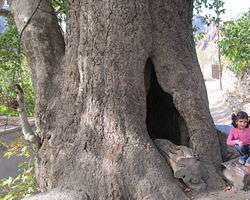
The landmark plain tree in Kavanaq village. | |
| Country |
 Iran Iran |
| Province | East Azerbaijan |
| County | Khoda Afarin |
| District | Minjavan |
| Population (2006) | |
| • Total | 2,888 |
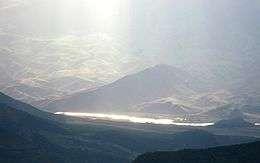
Dizmar-e Sharqi Rural District (Persian: دهستان دیزمار شرقی) is a rural district (dehestan) in Minjavan District, Khoda Afarin County, East Azerbaijan Province, Iran.[1] At the 2006 census, its population was 2,888, in 641 families.[2] The rural district has 15 villages.
A brief history
Dizmar has been first mentioned by the renowned historian Hamdallah Mustawfi in the mid fourteenth century, "Dizmar is a district in the north of Tabriz which includes more than 50 villages ..." [3] Mardanaqom, was also mentioned by Hamdallah Mustawfi as a thriving village.[3][4] The landmark, manifesting ancient history of the district, is an ancient plane tree in Kavanaq village (included on the map). The tree is about 3 meter in diameter and is said to have lived for 500 years. Moreover, on a mountain between Kavanaq and Mardanaqom, there is a castle dating from Sasanian era. It was used as a jail for high-ranking officials during Khwarazmian reign.[5]
In the wake of White Revolution (early 1960s) many clans of Qarāca Dāġ tribes used Dizmar as their winter quarters.[6] Eastern part of Dizmar was declared a part of Khoda Afarin County in 2011 [7] and Mardanaqom was designated as its capital.
References
- ↑ Iranian National Committee for Standardization of Geographical Names website (Persian)
- ↑ "Census of the Islamic Republic of Iran, 1385 (2006)". Islamic Republic of Iran. Archived from the original (Excel) on 2011-11-11.
- 1 2 نزهةالقلوب ، حمداله مستوفی ، به کوشش محمد دبیر سیاقی ، انتشارات کتابخانه طهوری ، چاپ اول ، تهران ، ۱۳۳۶، ص. ۱۰۱.
- ↑ نزهةالقلوب ، حمداله مستوفی ، به کوشش محمد دبیر سیاقی ، انتشارات کتابخانه طهوری ، چاپ اول ، تهران ، ۱۳۳۶، ص. ۹۶.
- ↑ Mohammadi, Vahid. "Mardanaqom Castle".
- ↑ P. Oberling, “The Tribes of Qarāca Dāġ,” Oriens 17, 1964, p. 60-95
- ↑ http://dolat.ir/NSite/FullStory/News/?Serv=0&Id=196474