Mardanaqom
| Mardanaqom مرداناقم | |
|---|---|
| village | |
|
Pomegranate orchards in rocky terrains | |
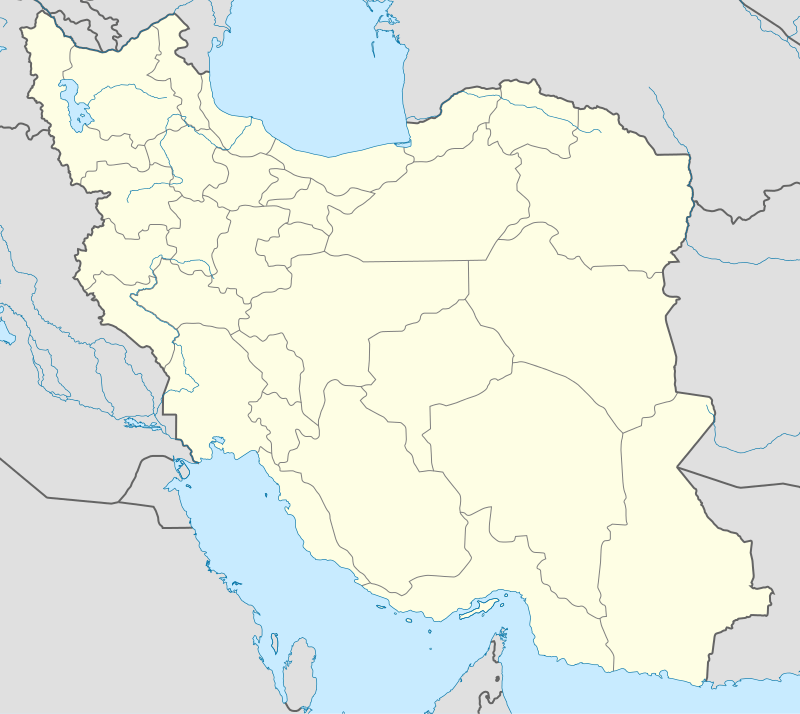  Mardanaqom | |
| Coordinates: 38°49′56″N 46°33′06″E / 38.83222°N 46.55167°ECoordinates: 38°49′56″N 46°33′06″E / 38.83222°N 46.55167°E | |
| Country |
 Iran Iran |
| Province | East Azerbaijan |
| County | Khoda Afarin |
| Bakhsh | Minjavan |
| Rural District | Dizmar-e Sharqi |
| Population (2006) | |
| • Total | 730 |
| Time zone | IRST (UTC+3:30) |
| • Summer (DST) | IRDT (UTC+4:30) |
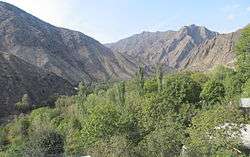
Mardanaqom (Persian: مردانقم, also Romanized as Mardānāqom; also known as Mard Agham, Mardānqom, Mardenaum, and Merdenaum)[1] is a village in Dizmar-e Sharqi Rural District, Minjavan District, Khoda Afarin County, East Azerbaijan Province, Iran. At the 2006 census, its population was 730, in 176 families.[2]
Situation
Mardanaqom has been first mentioned by the renowned historian Hamdallah Mustawfi in the late twelfth century.[3][4] At the time, apparently, Mardanaqom was the capital of a thriving district.
Online edition of the Dehkhoda Dictionary, quoting Iranian Army files,[5] reports a population of 639 people in late 1940s.[6] According to a more recent statistics (2012) the population is 605 people in 205 families.[7] Therefore, Mardanaqom is one of the most populated villages of Khoda Afarin County.
In 1986 Mardanaqom was designated as the capital of Dizmar-e Sharqi Rural District.[8]
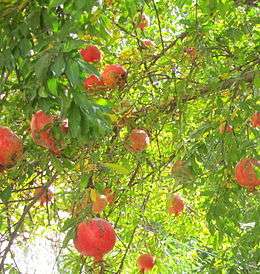
Pomegranate Festival
The village is a renowned center of Pomegranate and grape production in Arasbaran region. These produces have a characteristic potential of being preserved for over six months without requiring refrigeration. This feature was remarked by Robert Mignan, who traveled through Arasbaran in 1830s.[10] Every year, in the second half of October, a Pomegranate Festival is organized in by the provincial authorities in the village.[11][12][13] The main feature of the festival is performance of Ashugh music.
Further Information
On a mountain near the village, there is a castle dating from Sasanian era. It was used as a jail for high-ranking officials during Khwarazmian reign.[14] According to information provided by Mr. Sahand Jabbari, who is from the area, the castle is indeed located in the territory of the adjacent village, Kavanaq.
References
- ↑ Mardanaqom can be found at GEOnet Names Server, at this link, by opening the Advanced Search box, entering "-3074073" in the "Unique Feature Id" form, and clicking on "Search Database".
- ↑ "Census of the Islamic Republic of Iran, 1385 (2006)". Islamic Republic of Iran. Archived from the original (Excel) on 2011-11-11.
- ↑ نزهةالقلوب ، حمداله مستوفی ، به کوشش محمد دبیر سیاقی ، انتشارات کتابخانه طهوری ، چاپ اول ، تهران ، ۱۳۳۶، ص. ۹۶.
- ↑ نزهةالقلوب ، حمداله مستوفی ، به کوشش محمد دبیر سیاقی ، انتشارات کتابخانه طهوری ، چاپ اول ، تهران ، ۱۳۳۶، ص. ۱۰۱.
- ↑ فرهنگ جغرافیایی ایران، آبادیها، زیر نظر حسینعلی رزم آرا، تهران: سازمان جغرافیایی کشور، 1329، ج 4
- ↑ "Dehkhoda Dictionary". loghatnaameh.org.
- ↑ "East Azarbaijan Census of 2012" (PDF). ostan-as.gov.ir.
- ↑ "مرکز پژوهشها - ایجاد و تشکیل تعداد 30 دهستان شامل روستاها، مزارع مکانها در شهرستان اهر تابع استان آذربایجان شرقی". rc.majlis.ir.
- ↑ "Introduction to the Horticulture products of Mardanaqom". data.palizshop.ir.
- ↑ Robert Mignan, A Winter Journey Through Russia, the Caucasian Alps, and Georgia: Thence ..., Vol. 1, 1839, London, p. 125
- ↑ "Pomegranate Festival in Maranaqom".
- ↑ Akbarzadeh, Ali. "The first pomegranate festival".
- ↑ "The second pomegranate festival". isna.ir.
- ↑ Mohammadi, Vahid. "Mardanaqom Castle". tabriz92.ir.