ExoMars 2020 surface platform
| Names | ExoMars 2018 Surface Platform[1] | ||||
|---|---|---|---|---|---|
| Mission type | Mars lander and rover | ||||
| Operator | ESA & Roscosmos | ||||
| Website |
www | ||||
| Mission duration | Planned: ≥ 1 Earth year[2] | ||||
| Spacecraft properties | |||||
| Manufacturer | Lavochkin | ||||
| Launch mass |
Lander: 827.9 kg (1,825 lb) Rover: 310 kg (680 lb) | ||||
| Payload mass | Lander: 45 kg (99 lb) | ||||
| Start of mission | |||||
| Launch date | July 2020[3] | ||||
| Rocket | Proton-M/Briz-M | ||||
| Mars lander | |||||
| Landing date | ≈April 2021 | ||||
| |||||
The ExoMars 2020 surface platform is a planned robotic Mars lander, part of the ExoMars 2020 mission by the European Space Agency and the Roscosmos State Corporation.
The plan calls for a Russian launch vehicle to deliver the Russian-built surface platform as well as the ExoMars rover to Mars' surface.[4] Once safely landed, the platform will deploy the rover and will start a one Earth-year mission to investigate the surface environment at the landing site.[2]
The spacecraft was scheduled to launch in 2018 and land on Mars in early 2019,[4] but due to delays in European and Russian industrial activities and deliveries of the scientific payload, it was moved to the launch window in July 2020.[3]
Scientific instruments
The science payload mass is about 45 kg and consist of:[2]
- The lander radio-science experiment (LaRa) will study the internal structure of Mars, and will make precise measurements of the rotation and orientation of the planet by monitoring two-way Doppler frequency shifts between the surface platform and Earth. It will also detect variations in angular momentum due to the redistribution of masses, such as the migration of ice from the polar caps to the atmosphere. Developed by Belgium.
- The Habitability, Brine, Irradiation and Temperature (HABIT) package will investigate the amount of water vapour in the atmosphere, daily and seasonal variations in ground and air temperatures, and the UV radiation environment. Developed by Sweden.
- Meteorological package (METEO-M). Developed by Russia. The instrument will incorporate the following sensor packages:
- Pressure and humidity sensors (METEO-P, METEO-H). Developed by Finland.
- Radiation and dust sensors (RDM). Developed by Spain.
- Anisotropic magneto-resistance sensor to measure magnetic fields (AMR). Developed by Spain.
- A magnetometer named MAIGRET. Developed by Russia. The instrument will incorporate the Wave analyser module (WAM), developed by Czech Republic.
- Set of cameras to characterise the landing site environment (TSPP). Developed by Russia.
- Instrument interface and memory unit (BIP). Developed by Russia.
- IR Fourier spectrometer to study the atmosphere (FAST). Developed by Russia.
- Active neutron spectrometer and dosimeter (ADRON-EM). Developed by Russia.
- Multi-channel Diode-Laser Spectrometer for atmospheric investigations (M-DLS). Developed by Russia.
- Radio thermometer for soil temperatures (PAT-M). Developed by Russia.
- Dust particle size, impact, and atmospheric charging instrument suite (Dust Suite). Developed by Russia.
- A Seismometer named SEM. Developed by Russia.
- Gas chromatography-mass spectrometry for atmospheric analysis (MGAP). Developed by Russia.
- Power
Russia is evaluating the options to use of a radioisotope thermoelectric generator (RTG) to power the science instruments,[5] and a radioisotope heater unit (RHU) to provide thermal control on the frozen Martian surface.[6]
Landing site selection
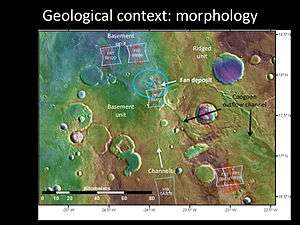
After a review by an ESA-appointed panel, a short list of four sites was formally recommended in October 2014 for further detailed analysis:[7][8]
On 21 October 2015, Oxia Planum was chosen as the preferred landing site for the ExoMars rover assuming a 2018 launch. Since the launch was postponed to 2020, Aram Dorsum and Mawrth Vallis will also be considered.[9][10]
References
- ↑ "ExoMars 2018 Surface Platform Experiment Proposal Information Package (pdf, 8.3 MB)". European Space Agency. 31 March 2015. Retrieved 4 October 2016.
- 1 2 3 "Exomars 2018 surface platform". European Space Agency. Retrieved 14 March 2016.
- 1 2 "N° 11–2016: Second ExoMars mission moves to next launch opportunity in 2020" (Press release). ESA. 2 May 2016. Retrieved 2 May 2016.
- 1 2 "Russia and Europe Team Up for Mars Missions". Space.com. 14 March 2013. Retrieved 24 January 2016.
- ↑ Amos, Jonthan (21 June 2013). "Looking forward to Europe's 'seven minutes of terror'". BBC News.
- ↑ Zak, Anatoly (3 March 2016). "ExoMars 2018". Russian Space Web. Retrieved 15 March 2016.
- ↑ "Four Candidate Landing Sites for ExoMars 2018". ESA. Space Ref. 1 October 2014. Retrieved 1 October 2014.
- ↑ "Recommendation for the Narrowing of ExoMars 2018 Landing Sites". ESA. 1 October 2014. Retrieved 1 October 2014.
- ↑ Amos, Jonathan (21 October 2015). "ExoMars rover: Landing preference is for Oxia Planum". BBC News. Retrieved 22 October 2015.
- ↑ Atkinson, Nancy (21 October 2015). "Scientists Want ExoMars Rover to Land at Oxia Planum". Universe Today. Retrieved 22 October 2015.
External links
- ExoMars 2020 by NPO Lavochkin (in Russian)
- ExoMars Rover and Surface Platform at ESA's Planetary Science Archive
ExoMars programme | ||||||||||||
|---|---|---|---|---|---|---|---|---|---|---|---|---|
| First launch (March 2016) |
|   .jpg) | ||||||||||
| Second launch (July 2020) |
| |||||||||||
| ||||||||||||


| Disciplines | |||||||||||||||||||
|---|---|---|---|---|---|---|---|---|---|---|---|---|---|---|---|---|---|---|---|
| Topics |
| ||||||||||||||||||
| Space missions |
| ||||||||||||||||||
| Related | |||||||||||||||||||
| |||||||||||||||||||

| Current |   .jpg) .jpg) | ||||||||||||||||||
|---|---|---|---|---|---|---|---|---|---|---|---|---|---|---|---|---|---|---|---|
| Past |
| ||||||||||||||||||
| Failed at launch | |||||||||||||||||||
| Planned |
| ||||||||||||||||||
| Proposed | |||||||||||||||||||
| Cancelled / concepts | |||||||||||||||||||
| Related |
| ||||||||||||||||||
† indicates failure en route or before intended mission data returned. | |||||||||||||||||||
| |||||||||||||||||||||||||||
| |||||||||||||||||||||||||||
| Telecommunications |
| ||||||||||||||||||||||||||
Technology demonstrators | |||||||||||||||||||||||||||
| Cancelled and proposed | |||||||||||||||||||||||||||
| Failed | |||||||||||||||||||||||||||


| Launch sites |  | ||||||||||||||
|---|---|---|---|---|---|---|---|---|---|---|---|---|---|---|---|
| Launch vehicles | |||||||||||||||
| Human spaceflight Programs |
| ||||||||||||||
| Robotic Programs |
| ||||||||||||||
| Communications | |||||||||||||||
| Concept |
| ||||||||||||||
