Proposed SLS and Orion Missions
The SLS/Orion program is NASA's new program for beyond Low-Earth Orbit spaceflight. There are a number of notional, proposed missions for the program, none of which are confirmed. Some of the currently proposed NASA Design Reference Missions (DRM) and others include:[1][2][3][4]
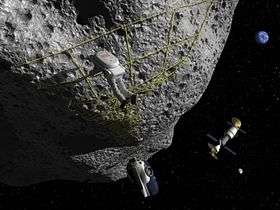
Artist's concept of an astronaut performing a tethering asteroid capture maneuver at a near-Earth object (NEO). The Space Exploration Vehicle is close by, with the Orion Multi-Purpose Crew Vehicle (MPCV) docked to the Deep Space Habitat in the background.
Unmanned missions
- Uranus orbiter and probe, SLS has been proposed by Boeing as a launch vehicle for a Uranian probe. The rocket would "Deliver a small payload into orbit around Uranus and a shallow probe into the planet’s atmosphere." The mission would study the Uranian atmosphere, magnetic and thermal characteristics, gravitational harmonics as well as do flybys of Uranian moons.[5][6]
- Titan Saturn System Mission, SLS has been proposed as a launch vehicle for a probe to Saturn and its moons.[7]
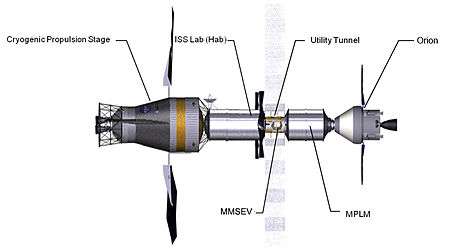 Artist's rendering of the Deep Space Habitat
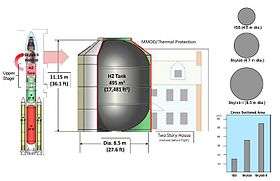
One section of the Skylab II Habitat would be made from the SLS Block 2 upper-stage hydrogen tank, similar to but larger than Skylab. A unique use for the SLS as no other vehicle is presently being designed with an 8-meter-diameter upper stage tank.
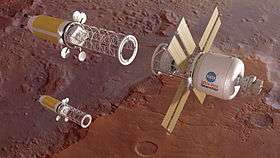
Artist's rendering of the proposed Mars Transfer Vehicle (MTV) "Searcher" that would incorporate NTR propulsion and inflatable habitat technology. A crewed Orion MPCV is docked on the right.
Cislunar missions
- Deep Space Habitat (DSH), NASA's planned usage of spare ISS hardware, experience, and modules for future missions to asteroids, Earth-Moon Lagrangian point and Mars.[8]
- Exploration Mission 3 is scheduled to be the second crewed mission of NASA's Orion on the Space Launch System.[9] NASA had previously planned for this mission to rendezvous with a captured asteroid boulder in cislunar space, however which mission this will be on is unknown.[10][11]
- EM-4 and EM-5 are notional cislunar missions similar to EM-3.
- BEO Orion missions
- 2033 Forward Work Martian Moon Phobos/Deimos, a crewed flexible path mission to one of the Martian moons. It would include 40 days in the vicinity of Mars and a return Venus flyby.
- 2037-2039 Forward Work Mars Landing, a crewed mission, with four to six astronauts,[12] to a semi-permanent habitat for at least 540 days on the surface of the red planet in 2033 or 2045. The mission would include in-orbit assembly, with the launch of seven SLS Block 2 heavy-lift vehicles (HLVs). The seven HLV payloads, three of which would contain nuclear propulsion modules, would be assembled in LEO into three separate vehicles for the journey to Mars; one cargo In-Situ Resource Utilization Mars Lander Vehicle (MLV) created from two HLV payloads, one Habitat MLV created from two HLV payloads and a crewed Mars Transfer Vehicle (MTV), known as "Copernicus", assembled from three HLV payloads launched a number of months later. Nuclear Thermal Rocket engines such as the Pewee of Project Rover were selected in the Mars Design Reference Architecture (DRA) study as they met mission requirements being the preferred propulsion option because it uses proven technology, has higher performance, lower launch mass, creates a versatile vehicle design, offers simple assembly, and has growth potential. A nuclear reactor serving as the power source for Ion propulsion was also an alternative option, in the case NTRs were not available.[1][13][14]
- Other proposed missions
- 2024 Single Shot MSR on SLS, a crewed flight with a telerobotic Mars Sample Return (MSR) mission proposed by NASA's Mars Program Planning Group. The time frame suggests SLS-5, a 105 t rocket to deliver an Orion capsule, SEP robotic vehicle, and Mars Ascent Vehicle (MAV). "Sample canister could be captured, inspected, encased and retrieved tele-robotically. Robot brings sample back and rendezvous with a crew vehicle." The mission may also include a "Possible Mars SEP (Solar Electric Power/Propulsion) Orbiter".[15]
- Potential sample return missions to Europa and Enceladus have also been noted.[16]
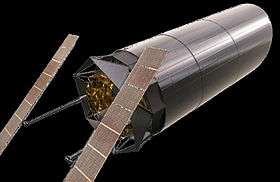
One proposed ATLAST concept, a design based on an 8-meter monolithic mirror. The Hubble Space Telescope by comparison is equipped with a 2.5 m main mirror. A telescope with an 8-meter monolithic mirror is possible only with a payload fairing bigger than 8 meters in diameter.
- Skylab II, proposal by Brand Griffin, an engineer with Gray Research Inc working with NASA Marshall, to use the upper stage hydrogen tank from SLS to build a 21st-century version of Skylab for future NASA missions to asteroids, Earth-Moon Lagrangian point-2 (EML2) and Mars.[17][18][19]
- Five Near Earth Asteroid (NEA) missions ranging from "minimum" to "full" capability are being studied. Among these are two NASA Near Earth Object (NEO) missions in 2026. A 155-day mission to NEO 1999 AO10, a 304-day mission to NEO 2001 GP2, a 490-day mission to a potentially hazardous asteroid such as 2000 SG344, utilizing two Block 1B SLS vehicles,[20] and a Boeing-proposed NEO mission to NEA 2008 EV5 in 2024. The latter would start from the proposed Earth-Moon L2 based Exploration Gateway Platform. Utilising an SLS third stage the trip would take about 100 days to arrive at the asteroid, 30 days for exploration, and a 235-day return trip to Earth.[21]
- High Altitude Venus Operational Concept, a manned Venus mission using two SLS Block 1B launches to send a crew of 2 to explore the atmosphere of Venus for 1 month, with retrieval in Earth orbit by a commercial crew vehicle or an Orion.[22][23][24][25]
- Advanced Technology Large-Aperture Space Telescope, SLS has been proposed by Boeing as a launch vehicle for the Advanced Technology Large-Aperture Space Telescope (ATLAST). This could be an 8 m monolithic telescope or a 16 m deployable telescope at Earth-Sun L2.[5]
References
- 1 2 Chris Bergin (24 January 2012). "SLS Exploration Roadmap evaluations provide clues for human Mars missions". NASASpaceflight.com. Retrieved 26 January 2012.
- ↑ Chris Bergin (15 December 2011). "Building the Roadmap for SLS – Con Ops lays out the LEO/Lunar Options". NASASpaceflight.com. Retrieved 26 January 2012.
- ↑ "SLS interest in DoD launch market and Secondary Payloads potential". NASASpaceFlight.com. 4 February 2012. Retrieved 9 April 2012.
- ↑ "NASA Exploration Roadmap: A return to the Moon's surface documented". NASASpaceFlight.com. 19 March 2012. Retrieved 9 April 2012.
- 1 2 Chris Gebhardt (20 November 2013). "New SLS mission options explored via new Large Upper Stage". NASASpaceFlight.
- ↑ http://www.boeing.com/assets/pdf/defense-space/space/sls/docs/sls_mission_booklet_jan_2014.pdf
- ↑ https://www.nasa.gov/sites/default/files/files/Creech_SLS_Deep_Space.pdf
- ↑ NASA's Deep Space Habitat
- ↑ Foust, Jeff (March 25, 2015). "NASA Selects Boulder Option for Asteroid Redirect Mission". Space News. Retrieved 2015-03-27.
- ↑ "SLS manifest options aim for Phobos prior to 2039 Mars landing".
- ↑ "NASA Announces Next Steps on Journey to Mars: Progress on Asteroid Initiative". 25 March 2015.
- ↑ Chris Bergin (October 6, 2013). "NASA Con Ops Assess Baseline Features for SLS/Orion Mission to Mars".
- ↑ https://www.nasaspaceflight.com/2015/09/nasa-considers-sls-launch-sequence-mars-missions-2030s/
- ↑ "Nuclear Thermal Propulsion (NTP): A Proven Growth Technology for Human NEO / Mars Exploration Missions" (PDF).
- ↑ Chris Bergin (30 November 2012). "NASA interest in 2024 Mars Sample Return Mission using SLS and Orion". NASASpaceFlight.com.
- ↑ http://www.nasaspaceflight.com/2012/11/nasa-payload-fairings-options-multi-mission-sls-capability/
- ↑ Markus Hammonds (14 April 2013). "Skylab II:Living Beyong the Dark Side of the Moon". Discovery.
- ↑ http://www.nasaspaceflight.com/2012/03/dsh-module-concepts-outlined-beo-exploration/
- ↑ Frank Morring, Jr. (22 October 2012). "NASA Deep-Space Program Gaining Focus". Aviation Week & Space Technology.
- ↑ "NASA managers evaluate yearlong deep space asteroid mission September 9, 2013 by Marshall Murphy".
- ↑ http://www.nasaspaceflight.com/2012/11/long-duration-iss-crew-foundations-beo-missions/
- ↑ https://www.youtube.com/watch?v=0az7DEwG68A
- ↑ http://sacd.larc.nasa.gov/branches/space-mission-analysis-branch-smab/smab-projects/havoc/
- ↑ http://www.space.com/29141-venus-airship-havoc-nasa-concept-gallery.html
- ↑ http://www.gizmag.com/nasa-havoc-concept-manned-mission-to-venus/35311/
| Policy and history |
|  | ||||||
|---|---|---|---|---|---|---|---|---|
| Robotic programs |
| |||||||
| Human spaceflight programs |
| |||||||
| Individual featured missions (human and robotic) | ||||||||
| Communications and Navigation | ||||||||
| NASA lists | ||||||||
| ||||||||


This article is issued from Wikipedia - version of the 10/30/2016. The text is available under the Creative Commons Attribution/Share Alike but additional terms may apply for the media files.