Iranian Islamic Republic referendum, March 1979
| Islamic Republic referendum | ||||||||||||||||
|---|---|---|---|---|---|---|---|---|---|---|---|---|---|---|---|---|
|
In the Name of the Almighty [God] Provisional Government of Islamic Revolution The Interior Ministry Referendum Election Ballot Age-old [monarchial] regime change to Islamic republic, the constitution of which will be approved by the nation — Yes or No?[1] | ||||||||||||||||
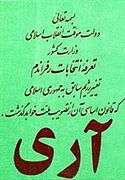 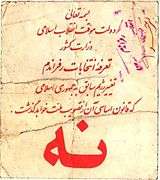 The two-parts ballot of referendum, with the green paper indicating "Yes" and red paper indicating "No"[1] | ||||||||||||||||
| Location | Iran | |||||||||||||||
| Date | 30—31 March 1979[2] | |||||||||||||||
| ||||||||||||||||


| This article is part of a series on the |
| Politics of the Islamic Republic of Iran |
|---|
 |
| Government of Islamic Republic of Iran |
|
Supreme Councils |
|
Local governments |
|
|
|
A referendum on creating an Islamic Republic was held in Iran on 30 and 31 March 1979.
Although some groups objected to the wording and choice and boycotted the referendum,[4] it was approved by 98.2% of eligible citizens, according to official results.[3]
In order to include the Iranian youth who participated in the revolution, the voting age was lowered from 18 to 16.[3]
Following this victory, the 1906 constitution was declared invalid and a new constitution for an Islamic state was created and ratified by another referendum in December 1979.
Party policies
Alternative wordings proposed
| “ | What the nation wants is an Islamic Republic, not one word more and not one word less. Not just a Republic, not a democratic Republic, not a democratic Islamic Republic. Do not use the word 'democratic' to describe it. This the Western style. | ” |
| — Ruhollah Khomeini's response to suggested names for the next regime[10] | ||
When the authorities were preparing to prescribe a name for future political system, the parties called for a referendum open to give third choices, other than monarchy and Islamic Republic. Some of the names suggested were:
- "Islamic Republic of Iran", by Islamic Republican Party[5]
- "People's Republic of Iran", by leftists[5]
- "Democratic Republic of Iran", by leftists[4]
- "Democratic Islamic Republic of Iran", by Freedom Movement of Iran[5]
- "Republic of Iran", by secular nationalists[4]
Results
| Choice | Votes | % |
|---|---|---|
| For | 20,147,855 | 99.3 |
| Against | 140,996 | 0.7 |
| Valid Votes | 20,288,851 | 100 |
| Source: [2] | ||
References
- 1 2 Hovsepian-Bearce, Yvette (2015). The Political Ideology of Ayatollah Khamenei: Out of the Mouth of the Supreme Leader of Iran. Routledge. p. 13. ISBN 1317605829.
- 1 2 3 Nohlen, Dieter; Grotz, Florian; Hartmann, Christof (2001). "Iran". Elections in Asia: A Data Handbook. I. Oxford University Press. p. 68. ISBN 0-19-924958-X.
- 1 2 3 Hiro, Dilip (2013). Holy Wars (Routledge Revivals): The Rise of Islamic Fundamentalism. Routledge. p. 169. ISBN 1135048312.
- 1 2 3 4 5 6 7 8 9 10 Paydar, Parvin (1995). Women and the Political Process in Twentieth-Century Iran. Cambridge University Press. p. 226. ISBN 978-0-521-59572-8.
- 1 2 3 4 5 6 Baktiari, Bahman (1996). Parliamentary Politics in Revolutionary Iran: The Institutionalization of Factional Politics. University Press of Florida. p. 55. ISBN 978-0-8130-1461-6.
- ↑ Haddad Adel, Gholamali; Elmi, Mohammad Jafar; Taromi-Rad, Hassan. Political Parties: Selected Entries from Encyclopaedia of the World of Islam. EWI Press. pp. 209–215. ISBN 9781908433022.
- ↑ Hiro, Dilip (2013). Iran Under the Ayatollahs (Routledge Revivals). Routledge. p. 128. ISBN 1135043817.
- ↑ Maziar, Behrooz (2000). Rebels With A Cause: The Failure of the Left in Iran. I.B.Tauris. p. 109. ISBN 1860646301.
- 1 2 Romano, David (2006). The Kurdish Nationalist Movement: Opportunity, Mobilization and Identity. Cambridge Middle East studies, 22. Cambridge University Press. p. 236. ISBN 978-0-521-85041-4. OCLC 61425259.
- ↑ Ganji, Manouchehr (2002). Defying the Iranian Revolution: From a Minister to the Shah to a Leader of Resistance. Greenwood Publishing Group. p. 77. ISBN 0275971872.
| Presidential elections | |
|---|---|
| Parliamentary elections | |
| Senate elections | |
| Assembly of Experts elections | |
| Local councils elections | |
| Constitutional Assembly elections | |
| Referendums | |