Nikon D810
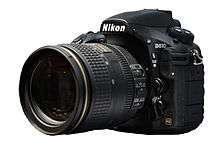 | |
| Overview | |
|---|---|
| Type | Digital single-lens reflex |
| Lens | |
| Lens | Interchangeable, Nikon F-mount |
| Sensor/Medium | |
| Sensor | 35.9 × 24 mm Full Frame FX format CMOS, 4.88 µm pixel size |
| Maximum resolution |
7360 × 4912 pixels (36.3 megapixels) |
| ASA/ISO range | 64–12800, extended mode 32 to 51,200 |
| Storage | CompactFlash (Type I, UDMA compliant) and Secure Digital (UHS-I compliant; SDHC, SDXC compatible and with Eye-Fi WLAN support) |
| Focusing | |
| Focus modes | Instant single-servo (AF-S); continuous-servo (AF-C); auto AF-S/AF-C selection (AF-A); manual (M) |
| Focus areas | Multi-CAM 3500FX 51-point AF |
| Exposure/Metering | |
| Exposure bracketing | 2 to 9 frames in 1/3, 1/2, 2/3, or 1 EV steps, up to 8 EV range. Or 2 to 5 frames in steps of 2 or 3 EV, up to 12 EV range |
| Exposure modes | Programmed Auto [P], Shutter-Priority Auto [S], Aperture-Priority Auto [A], Manual [M] |
| Exposure metering | TTL 3D Color Matrix Metering III with a 91,000-pixel RGB sensor |
| Metering modes | Matrix, center-weighted, spot, highlight-weighted metering |
| Flash | |
| Flash | Manual pop-up with button release Guide number 12/39 (ISO 100, m/ft) |
| Flash bracketing | -3 to +3 EV in increments of 1/3, 1/2, 2/3, or 1 EV; 2 to 5 frames in steps of 2 or 3 EV |
| Shutter | |
| Shutter | Electronically controlled vertical-travel focal-plane shutter |
| Shutter speed range | 1/8000 to 30 s, bulb, X-sync at 1/250 s. |
| Continuous shooting | 5 frames per second; 6 per second in DX and 1.2× crop modes; 7 per second with battery grip in DX and 1.2× crop modes |
| Viewfinder | |
| Viewfinder | Optical pentaprism, 100% coverage, approx. 0.70× magnification |
| Image Processing | |
| Custom WB | Flat, Landscape, Monochrome, Neutral, Portrait, Standard, Vivid, Custom: Picture Control 2.0 |
| WB bracketing | 2 to 9 frames in 1/3, 1/2, 2/3, or 1 EV steps |
| Dynamic range bracketing | 2 frames using selected value for one frame or 3 to 5 frames using preset values for all frames |
| Dynamic range compressor | Active D-Lighting: auto, extra high, high, normal, low or off |
| General | |
| Rear LCD monitor | 3.2 inch, 1229k-dot RGBW VGA resolution |
| Battery | Nikon EN-EL15a/EN-EL15 rechargeable lithium-ion battery |
| AV Port(s) | HDMI C (mini) |
| Data Port(s) | USB 3.0, Nikon 10-Pin |
| Weight | 880 g (31 oz), 980 g (35 oz) with battery |
The Nikon D810 is a 36.3-megapixel professional-grade full-frame digital single-lens reflex camera produced by Nikon. The camera was officially announced in June 2014, and began shipping in July 2014.
Compared to the former D800/D800E[1] it offers an image sensor with a base sensitivity of ISO 64 and extended range of ISO 32 to 51,200, an Expeed processor with noise reduction with claimed 1 stop noise improvement, doubled buffer size, increased frame rate and extended battery life, improved autofocus - now similar to the D4S, improved video with 1080p 60 fps and many software improvements.
Features
- New 37.09 megapixel (36.3 effective) full-frame (35.9 mm × 24 mm) sensor with sensitivity of ISO 64–12,800 (ISO 32-51,200 boost) and no optical low-pass filter (OLPF, anti-aliasing filter)[2]
- Improved microlenses with increased light gathering
- Nikon Expeed 4 image processor with improved noise reduction, moiré (aliasing) reduction and increased battery life to 1200 shots / 40 minutes video notwithstanding 30% higher speed
- Roughly doubled buffer size of D800/D800E[3]
- Frame rate (photo) increased to 5 fps FX (full-frame, DX up to 7 fps). Videos up to 1080p 60p / 50p fps
- Simultaneous video recoding on external recorder (uncompressed video, clean HDMI; up to 1080p60) and compressed on memory card
- Autofocus equivalent to D4S, also Group Area mode: uses five AF sensors together. Face-detection switchable with custom settings
- Highlight Weighted Metering preventing blown highlights or underexposed shadows. Also Highlight Display with Zebra Stripes and full aperture metering during live view and video
- Kevlar/carbon fiber composite shutter with reduced lag, vibrations and shutter noise. Redesigned Sequencer / Balancer Mechanism for Quiet and Quiet Continuous modes
- Electronic front curtain shutter for further reduced vibrations enabling higher resolutions
- OLED viewfinder display
- Timelapse up to 9,999 frames, additionally timelapse videos. Timelapse / Interval Timer Exposure Smoothing
- Customizable 'Picture Control 2.0' options: Flat affecting dynamic range (preserve highlights and shadows), Clarity affecting details. Other settings affecting exposure, white balance, sharpness, brightness, saturation, hue; allowing custom curves to be created, edited, saved, exported and imported
- 3.2" 1229k-dot (RGBW, four dots per pixel: extra white dot) VGA LCD display with "Split-screen display zoom" function
- USB 3.0, HDMI C (mini), Nikon 10-Pin interfaces and 3.5mm/1/8″ stereo headphone + 3.5mm/1/8″ stereo microphone connectors
- "Superior" resistance to dust and water (Nikon claim)[4]
Accessories
- Nikon WT-4/WT-4A or WT-5/WT-5A (also UT-1 network) Wireless Transmitter for WLAN. Third-party solutions available.[5]
- Nikon Wireless remote control or third-party solutions.[6]
- Nikon GP-1 or GP-1A GPS Unit for direct GPS geotagging. Third-party solutions partly with three-axis compass, data-logger, bluetooth and support for indoor use are available from Solmeta,[7] Dawn,[8] Easytag,[9] Foolography,[10] Gisteq[11] and Phottix.[12] See comparisons/reviews.[13][14][15]
- Nikon Battery grip or third-party solutions
- Various Nikon Speedlight or third-party flash units.[16] Also working as commander for Nikon Creative Lighting System wireless (slave) flash.
- Third-party radio (wireless) flash control triggers
- Tethered shooting with Nikon Camera Control Pro 2, third-party solutions or open-source software and apps
- Other accessories from Nikon and third parties, including protective cases and bags, eyepiece adapters and correction lenses, and underwater housings.
- Nikon D810 animator's kit[17] including the AF-S VR Micro-NIKKOR 105mm f/2.8G, Dragonframe 3.5 software, power supply and cables
- Nikon D810 DSLR Filmmaker's Kit[18] including three fast prime lenses, a portable HDMI recorder using "Pro" codecs,[19] but not capable for storing uncompressed video,[20] ME-1 Stereo Microphone, filters, batteries and cables
Reception
| Images | |
|---|---|
 Nikon D810 sample, review and user images, >20MPix. Google Image search Nikon D810 sample, review and user images, >20MPix. Google Image search | |
|
Nikon D810 large images at Flickr | |
| Video | |
 Nikon D810 1080p sample, review and user videos: Google search Nikon D810 1080p sample, review and user videos: Google search |
At the time of its release, the Nikon D810 became the Dxomark image sensor leader[21] ahead of the Nikon D800E and received many reviews.[22][23]
Service advisory
On August 19, 2014, Nikon acknowledged a problem reported by some users, of bright spots appearing in long-exposure photographs as well as "in some images captured at an Image area setting of 1.2x (30x20)."[24][25] Existing owners of D810 cameras were asked to visit a website to determine whether their camera could be affected, on the basis of serial numbers. Repairs would be made by Nikon free of charge.[24][25] If bright spots still appear in images after servicing, Nikon recommends enabling Long exposure NR.[26] Products already serviced have a black dot inside the tripod socket.[26]
Nikon D810A
An astrophotography variant with a special infrared filter capable of deep red / near infrared and with special software tweaks like long-exposure modes up to 15 minutes, virtual horizon indicator and a special Astro Noise Reduction software was announced February 10, 2015.[27] [28] The D810A's IR filter is optimized for H-alpha (Hα) red tones, resulting in four times greater sensitivity to the 656 nm wavelength than the D810.[29] In comparison, Canon's astrophotography DSLR's 20Da and 60Da Hα sensitivity was 2.5 times and 3 times (respectively) more than the standard 20D / 60D.[30] The D810A additionally has 1.39 stops advantage due to the larger image sensor format – resulting in better than 2 stops sensitivity advantage giving over four times faster exposure times compared to the Canon 20Da/60Da.
| Images | |
|---|---|
|
Nikon D810A sample, review and user images, >20MPix. Google Image search | |
|
Nikon D810A large images at Flickr | |
| Video | |
|
Nikon D810A 1080p sample, review and user videos: Google search |
Although the D810A can be used for normal photography, due to the deep red / near infrared sensitivity the in-camera white balance may fail in case of fluorescent light or difficult cases with very strong infrared light – requiring an external infrared filter. Nikon published an D810A astrophotography guide which recommends live view focussing with 23x enlarged selected areas[31] and a gallery showing the mostly small effects to the color reproduction in "normal" photos.[32]
A review concludes that especially the D810A long exposure noise is superior compared to the D800E and other Nikon fullframes, and shows effects of the increased H-alpha sensitivity. Color balance of "normal" photos seems mostly correct, except comparatively hotter objects with strong infrared radiation and a bit more purple in sunsets.[33]
References
- ↑ Nikon D810 - D800/D800E Comparison Sheet Nikon
- ↑ Nikon D810 launched new 36.3-megapixel sensor
- ↑ Nikon D810 Buffer Size Photographylife
- ↑ Digital SLR camera D810: An effective pixel count of 36.3-million pixels for the sharpest, best image quality in Nikon history Nikon
- ↑ Eye-Fi Wi-Fi network: how it works Eye-fi
- ↑ PHOTTIX CLEON II Wired and Wireless shutter Phottix
- ↑ Solmeta Geotaggers Solmeta
- ↑ Dawn di-GPS Products Dawn
- ↑ EasyTag GPS and Wireless Bluetooth Modules Easytag
- ↑ Foolography Unleashed Bluetooth Geotagging Foolography
- ↑ Gisteq PhotoTrackr Plus for Nikon DSLR (Bluetooth) Gisteq
- ↑ Phottix Geo One GPS Phottix
- ↑ Nikon DSLR GPS Smack Down Results Terrywhite
- ↑ Review: Geotagging with Easytag GPS module (Nikon GP-1 compatible) Trick77
- ↑ Review: blueSLR Wireless Camera Control & GPS Geotagging Terrywhite
- ↑ Flash Units Compatible with Nikon's CLS including Wireless Master Dpanswers
- ↑ Nikon D810 animator's kit Nikon Cinema
- ↑ Nikon D810 FILMMAKER'S KIT Nikon Cinema
- ↑ Portable HD Field Recorder, Monitor, Playback And Playout Devices Atomos
- ↑ The world's smallest uncompressed video recorder Blackmagic
- ↑ Nikon D810 sensor review: New DxOMark leader DXOmark
- ↑ Nikon D810 tests, reviews, articles, ratings, and ranks NikonIndex
- ↑ Nikon D810 Review Imaging Resource
- 1 2 http://diglloyd.com/blog/2014/20140819_0755-NikonD810-service-advisory.html
- 1 2 http://www.nikonusa.com/en/Service-And-Support/Service-Advisories/hyvanded/Technical-Service-Advisory-for-Users-of-the-Nikon-D810.html
- 1 2 https://nikoneurope-en.custhelp.com/app/answers/detail/a_id/61871
- ↑ Nikon D810A Review -- First Impressions
- ↑ "Digital SLR Camera D810A". Retrieved February 11, 2015.
- ↑ "DSLR for Astrophotography". Retrieved February 11, 2015.
- ↑ Dyer, Alan (September 2012). "The 60Da: Canon's Astrophoto DSLR". Sky & Telescope. 124 (3): 38–41. ISSN 0037-6604.
- ↑ Nikon D810A Shooting Guide: Astrophotography tips Nikon
- ↑ Nikon D810A Shooting Guide: Color reproduction of the D810A with non-astronomical subjects Nikon
- ↑ Fotograf Göran Strand: Nikon D810A Review Astrofotografen
External links
 |
Wikimedia Commons has media related to |
- Nikon D810, Nikon USA
- Nikon D810A, Nikon USA
- Nikon D810 - D800/D800E Comparison Sheet Nikon
- D810-D810A Comparison Sheet Nikon
- Nikon D810 User Manuals, Guides and Software Nikon Download-center
- Nikon D810A User Manuals, Guides and Software Nikon Download-center
- Nikon D810 Review Imaging Resource
| Nikon DSLR timeline (comparison) | |||||||||||||||||||||||||||||||||||||||||||||||||||||||||||||||||||||||||||||||||||||||||||||||||||||||||||||||||||||||||||||||||||||||||||||||||||||||||||||||||||||||||||||||||||||||||||||||||||||||||||||||||||||||||||||||||||||||||||||||||||||||||||||||||||||||||||||||||||||||||||||||||||||||||||||||||||||||||||||||||||||||||||||||||||||||||||||||||||||||||||||||||||||||||||||||||||||||||||||||||||||||||||||||||||||||||||||||||||||||||||||||||||||||||||||||||||||||||||||||||||||||||||||||||||||||||||||||||||||||||||||||||||||||||||||||||||||||||||||||||||||||||||||||||||||||||||||||||||||||||||||||||||||||||||||||||||||||||||||||||||||||||||||||||||||||||||||||||||||||||||||||||||||||||||||||||||||||||||||||||||||||||||||||||||||||||||||||||||||||||||||||||||||||||||||||||||||||||||||||||||||||||||||||||||||||||||||||||||||||||||||||||||||||||||||||||||||||||||||||||||||||||||||||||||||||||||||||||||||||||||||||||||||||||||||||||||||||||||||||||||||||||||||||||||||||
|---|---|---|---|---|---|---|---|---|---|---|---|---|---|---|---|---|---|---|---|---|---|---|---|---|---|---|---|---|---|---|---|---|---|---|---|---|---|---|---|---|---|---|---|---|---|---|---|---|---|---|---|---|---|---|---|---|---|---|---|---|---|---|---|---|---|---|---|---|---|---|---|---|---|---|---|---|---|---|---|---|---|---|---|---|---|---|---|---|---|---|---|---|---|---|---|---|---|---|---|---|---|---|---|---|---|---|---|---|---|---|---|---|---|---|---|---|---|---|---|---|---|---|---|---|---|---|---|---|---|---|---|---|---|---|---|---|---|---|---|---|---|---|---|---|---|---|---|---|---|---|---|---|---|---|---|---|---|---|---|---|---|---|---|---|---|---|---|---|---|---|---|---|---|---|---|---|---|---|---|---|---|---|---|---|---|---|---|---|---|---|---|---|---|---|---|---|---|---|---|---|---|---|---|---|---|---|---|---|---|---|---|---|---|---|---|---|---|---|---|---|---|---|---|---|---|---|---|---|---|---|---|---|---|---|---|---|---|---|---|---|---|---|---|---|---|---|---|---|---|---|---|---|---|---|---|---|---|---|---|---|---|---|---|---|---|---|---|---|---|---|---|---|---|---|---|---|---|---|---|---|---|---|---|---|---|---|---|---|---|---|---|---|---|---|---|---|---|---|---|---|---|---|---|---|---|---|---|---|---|---|---|---|---|---|---|---|---|---|---|---|---|---|---|---|---|---|---|---|---|---|---|---|---|---|---|---|---|---|---|---|---|---|---|---|---|---|---|---|---|---|---|---|---|---|---|---|---|---|---|---|---|---|---|---|---|---|---|---|---|---|---|---|---|---|---|---|---|---|---|---|---|---|---|---|---|---|---|---|---|---|---|---|---|---|---|---|---|---|---|---|---|---|---|---|---|---|---|---|---|---|---|---|---|---|---|---|---|---|---|---|---|---|---|---|---|---|---|---|---|---|---|---|---|---|---|---|---|---|---|---|---|---|---|---|---|---|---|---|---|---|---|---|---|---|---|---|---|---|---|---|---|---|---|---|---|---|---|---|---|---|---|---|---|---|---|---|---|---|---|---|---|---|---|---|---|---|---|---|---|---|---|---|---|---|---|---|---|---|---|---|---|---|---|---|---|---|---|---|---|---|---|---|---|---|---|---|---|---|---|---|---|---|---|---|---|---|---|---|---|---|---|---|---|---|---|---|---|---|---|---|---|---|---|---|---|---|---|---|---|---|---|---|---|---|---|---|---|---|---|---|---|---|---|---|---|---|---|---|---|---|---|---|---|---|---|---|---|---|---|---|---|---|---|---|---|---|---|---|---|---|---|---|---|---|---|---|---|---|---|---|---|---|---|---|---|---|---|---|---|---|---|---|---|---|---|---|---|---|---|---|---|---|---|---|---|---|---|---|---|---|---|---|---|---|---|---|---|---|---|---|---|---|---|---|---|---|---|---|---|---|---|---|---|---|---|---|---|---|---|---|---|---|---|---|---|---|---|---|---|---|---|---|---|---|---|---|---|---|---|---|---|---|---|---|---|---|---|---|---|---|---|---|---|---|---|---|---|---|---|---|---|---|---|---|---|---|---|---|---|---|---|---|---|---|---|---|---|---|---|---|---|---|---|---|---|---|---|---|---|---|---|---|---|---|---|---|---|---|---|---|---|---|---|---|---|---|---|---|---|---|---|---|---|---|---|---|---|---|---|---|---|---|---|---|---|---|---|---|---|---|---|---|---|---|---|---|---|---|---|---|---|---|---|---|---|---|---|---|---|---|---|---|---|---|---|---|---|---|---|---|---|---|---|---|---|---|---|---|---|---|---|---|---|---|---|---|---|---|---|---|---|---|---|---|---|---|---|---|---|---|---|---|---|---|---|---|---|---|---|---|---|---|---|---|---|---|---|---|---|---|---|---|---|---|---|---|---|---|---|---|---|---|---|---|---|---|---|---|---|---|---|---|---|---|---|---|---|---|---|---|---|---|---|---|---|---|---|---|---|---|---|---|---|---|---|---|---|---|---|---|---|---|---|---|---|---|---|---|---|---|---|---|---|---|---|---|---|---|---|---|---|---|---|---|---|---|---|---|---|---|---|---|---|---|---|---|---|---|---|---|---|---|---|---|---|---|---|---|---|---|---|---|---|---|---|---|---|---|---|---|---|---|---|---|---|---|---|---|---|---|---|---|---|---|---|---|---|---|---|---|---|---|---|
See also: Nikon 1 / F-mount – Teleconverter – CX / DX format – Speedlight – Expeed | |||||||||||||||||||||||||||||||||||||||||||||||||||||||||||||||||||||||||||||||||||||||||||||||||||||||||||||||||||||||||||||||||||||||||||||||||||||||||||||||||||||||||||||||||||||||||||||||||||||||||||||||||||||||||||||||||||||||||||||||||||||||||||||||||||||||||||||||||||||||||||||||||||||||||||||||||||||||||||||||||||||||||||||||||||||||||||||||||||||||||||||||||||||||||||||||||||||||||||||||||||||||||||||||||||||||||||||||||||||||||||||||||||||||||||||||||||||||||||||||||||||||||||||||||||||||||||||||||||||||||||||||||||||||||||||||||||||||||||||||||||||||||||||||||||||||||||||||||||||||||||||||||||||||||||||||||||||||||||||||||||||||||||||||||||||||||||||||||||||||||||||||||||||||||||||||||||||||||||||||||||||||||||||||||||||||||||||||||||||||||||||||||||||||||||||||||||||||||||||||||||||||||||||||||||||||||||||||||||||||||||||||||||||||||||||||||||||||||||||||||||||||||||||||||||||||||||||||||||||||||||||||||||||||||||||||||||||||||||||||||||||||||||||||||||||||