Somatostatin receptor 2

| View/Edit Human | View/Edit Mouse |
Somatostatin receptor type 2 is a protein that in humans is encoded by the SSTR2 gene.[3]
Function
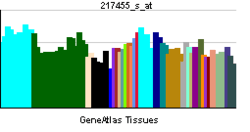
Somatostatin acts at many sites to inhibit the release of many hormones and other secretory proteins. The biologic effects of somatostatin are probably mediated by a family of G protein-coupled receptors that are expressed in a tissue-specific manner. SSTR2 is a member of the superfamily of receptors having seven transmembrane segments and is expressed in highest levels in cerebrum and kidney.[4]
Interactions
Somatostatin receptor 2 has been shown to interact with SHANK2.[5]
Therapeutic targeting
Most pituitary adenomas express SSTR2, but other somatostatin receptors are also found.<[6] Somatostatin analogs (i.e. Octreotide, Lanreotide ) are used to stimulate this receptors, and thus to inhibit further tumor proliferation.[7]
See also
References
- ↑ "Human PubMed Reference:".
- ↑ "Mouse PubMed Reference:".
- ↑ Yamada Y, Stoffel M, Espinosa R, Xiang KS, Seino M, Seino S, Le Beau MM, Bell GI (Feb 1993). "Human somatostatin receptor genes: localization to human chromosomes 14, 17, and 22 and identification of simple tandem repeat polymorphisms". Genomics. 15 (2): 449–52. doi:10.1006/geno.1993.1088. PMID 8449518.
- ↑ "Entrez Gene: SSTR2 somatostatin receptor 2".
- ↑ Zitzer H, Hönck HH, Bächner D, Richter D, Kreienkamp HJ (Nov 1999). "Somatostatin receptor interacting protein defines a novel family of multidomain proteins present in human and rodent brain". The Journal of Biological Chemistry. 274 (46): 32997–3001. doi:10.1074/jbc.274.46.32997. PMID 10551867.
- ↑ Miller GM, Alexander JM, Bikkal HA, Katznelson L, Zervas NT, Klibanski A (Apr 1995). "Somatostatin receptor subtype gene expression in pituitary adenomas". The Journal of Clinical Endocrinology and Metabolism. 80 (4): 1386–92. doi:10.1210/jcem.80.4.7714115. PMID 7714115.
- ↑ Zatelli MC, Ambrosio MR, Bondanelli M, Uberti EC (Apr 2007). "Control of pituitary adenoma cell proliferation by somatostatin analogs, dopamine agonists and novel chimeric compounds". European Journal of Endocrinology / European Federation of Endocrine Societies. 156 Suppl 1: S29–35. doi:10.1530/eje.1.02352. PMID 17413185.
Further reading
- Yamada Y, Post SR, Wang K, Tager HS, Bell GI, Seino S (Jan 1992). "Cloning and functional characterization of a family of human and mouse somatostatin receptors expressed in brain, gastrointestinal tract, and kidney". Proceedings of the National Academy of Sciences of the United States of America. 89 (1): 251–5. doi:10.1073/pnas.89.1.251. PMC 48214
 . PMID 1346068.
 - Reubi JC, Waser B, Schaer JC, Markwalder R (Sep 1995). "Somatostatin receptors in human prostate and prostate cancer". The Journal of Clinical Endocrinology and Metabolism. 80 (9): 2806–14. doi:10.1210/jc.80.9.2806. PMID 7673428.
- Kagimoto S, Yamada Y, Kubota A, Someya Y, Ihara Y, Yasuda K, Kozasa T, Imura H, Seino S, Seino Y (Jul 1994). "Human somatostatin receptor, SSTR2, is coupled to adenylyl cyclase in the presence of Gi alpha 1 protein". Biochemical and Biophysical Research Communications. 202 (2): 1188–95. doi:10.1006/bbrc.1994.2054. PMID 7914078.
- Fujita T, Yamaji Y, Sato M, Murao K, Takahara J (1994). "Gene expression of somatostatin receptor subtypes, SSTR1 and SSTR2, in human lung cancer cell lines". Life Sciences. 55 (23): 1797–806. doi:10.1016/0024-3205(94)90090-6. PMID 7968260.
- Patel YC, Greenwood M, Kent G, Panetta R, Srikant CB (Apr 1993). "Multiple gene transcripts of the somatostatin receptor SSTR2: tissue selective distribution and cAMP regulation". Biochemical and Biophysical Research Communications. 192 (1): 288–94. doi:10.1006/bbrc.1993.1412. PMID 8386508.
- Fukusumi S, Kitada C, Takekawa S, Kizawa H, Sakamoto J, Miyamoto M, Hinuma S, Kitano K, Fujino M (Mar 1997). "Identification and characterization of a novel human cortistatin-like peptide". Biochemical and Biophysical Research Communications. 232 (1): 157–63. doi:10.1006/bbrc.1997.6252. PMID 9125122.
- Jaïs P, Terris B, Ruszniewski P, LeRomancer M, Reyl-Desmars F, Vissuzaine C, Cadiot G, Mignon M, Lewin MJ (Aug 1997). "Somatostatin receptor subtype gene expression in human endocrine gastroentero-pancreatic tumours". European Journal of Clinical Investigation. 27 (8): 639–44. doi:10.1046/j.1365-2362.1997.1740719.x. PMID 9279525.
- Lopez F, Estève JP, Buscail L, Delesque N, Saint-Laurent N, Théveniau M, Nahmias C, Vaysse N, Susini C (Sep 1997). "The tyrosine phosphatase SHP-1 associates with the sst2 somatostatin receptor and is an essential component of sst2-mediated inhibitory growth signaling". The Journal of Biological Chemistry. 272 (39): 24448–54. doi:10.1074/jbc.272.39.24448. PMID 9305905.
- Tsutsumi A, Takano H, Ichikawa K, Kobayashi S, Koike T (Oct 1997). "Expression of somatostatin receptor subtype 2 mRNA in human lymphoid cells". Cellular Immunology. 181 (1): 44–9. doi:10.1006/cimm.1997.1193. PMID 9344495.
- Sharma K, Patel YC, Srikant CB (Jan 1999). "C-terminal region of human somatostatin receptor 5 is required for induction of Rb and G1 cell cycle arrest". Molecular Endocrinology. 13 (1): 82–90. doi:10.1210/me.13.1.82. PMID 9892014.
- Kumar U, Sasi R, Suresh S, Patel A, Thangaraju M, Metrakos P, Patel SC, Patel YC (Jan 1999). "Subtype-selective expression of the five somatostatin receptors (hSSTR1-5) in human pancreatic islet cells: a quantitative double-label immunohistochemical analysis". Diabetes. 48 (1): 77–85. doi:10.2337/diabetes.48.1.77. PMID 9892225.
- Zitzer H, Richter D, Kreienkamp HJ (Jun 1999). "Agonist-dependent interaction of the rat somatostatin receptor subtype 2 with cortactin-binding protein 1". The Journal of Biological Chemistry. 274 (26): 18153–6. doi:10.1074/jbc.274.26.18153. PMID 10373412.
- Zitzer H, Hönck HH, Bächner D, Richter D, Kreienkamp HJ (Nov 1999). "Somatostatin receptor interacting protein defines a novel family of multidomain proteins present in human and rodent brain". The Journal of Biological Chemistry. 274 (46): 32997–3001. doi:10.1074/jbc.274.46.32997. PMID 10551867.
- Petersenn S, Rasch AC, Presch S, Beil FU, Schulte HM (Nov 1999). "Genomic structure and transcriptional regulation of the human somatostatin receptor type 2". Molecular and Cellular Endocrinology. 157 (1-2): 75–85. doi:10.1016/S0303-7207(99)00161-6. PMID 10619399.
- Kreienkamp HJ, Zitzer H, Richter D (2001). "Identification of proteins interacting with the rat somatostatin receptor subtype 2". Journal of Physiology, Paris. 94 (3-4): 193–8. doi:10.1016/S0928-4257(00)00204-7. PMID 11087996.
- Ho MK, Yung LY, Chan JS, Chan JH, Wong CS, Wong YH (Apr 2001). "Galpha(14) links a variety of G(i)- and G(s)-coupled receptors to the stimulation of phospholipase C". British Journal of Pharmacology. 132 (7): 1431–40. doi:10.1038/sj.bjp.0703933. PMC 1572686. PMID 11264236.
- Zatelli MC, Tagliati F, Taylor JE, Rossi R, Culler MD, degli Uberti EC (May 2001). "Somatostatin receptor subtypes 2 and 5 differentially affect proliferation in vitro of the human medullary thyroid carcinoma cell line tt". The Journal of Clinical Endocrinology and Metabolism. 86 (5): 2161–9. doi:10.1210/jc.86.5.2161. PMID 11344221.
- Talme T, Ivanoff J, Hägglund M, Van Neerven RJ, Ivanoff A, Sundqvist KG (Jul 2001). "Somatostatin receptor (SSTR) expression and function in normal and leukaemic T-cells. Evidence for selective effects on adhesion to extracellular matrix components via SSTR2 and/or 3". Clinical and Experimental Immunology. 125 (1): 71–9. doi:10.1046/j.1365-2249.2001.01577.x. PMC 1906108. PMID 11472428.
- Klisovic DD, O'Dorisio MS, Katz SE, Sall JW, Balster D, O'Dorisio TM, Craig E, Lubow M (Sep 2001). "Somatostatin receptor gene expression in human ocular tissues: RT-PCR and immunohistochemical study". Investigative Ophthalmology & Visual Science. 42 (10): 2193–201. PMID 11527930.
External links
- "Somatostatin Receptors: sst2". IUPHAR Database of Receptors and Ion Channels. International Union of Basic and Clinical Pharmacology.
- somatostatin receptor 2 at the US National Library of Medicine Medical Subject Headings (MeSH)
This article incorporates text from the United States National Library of Medicine, which is in the public domain.